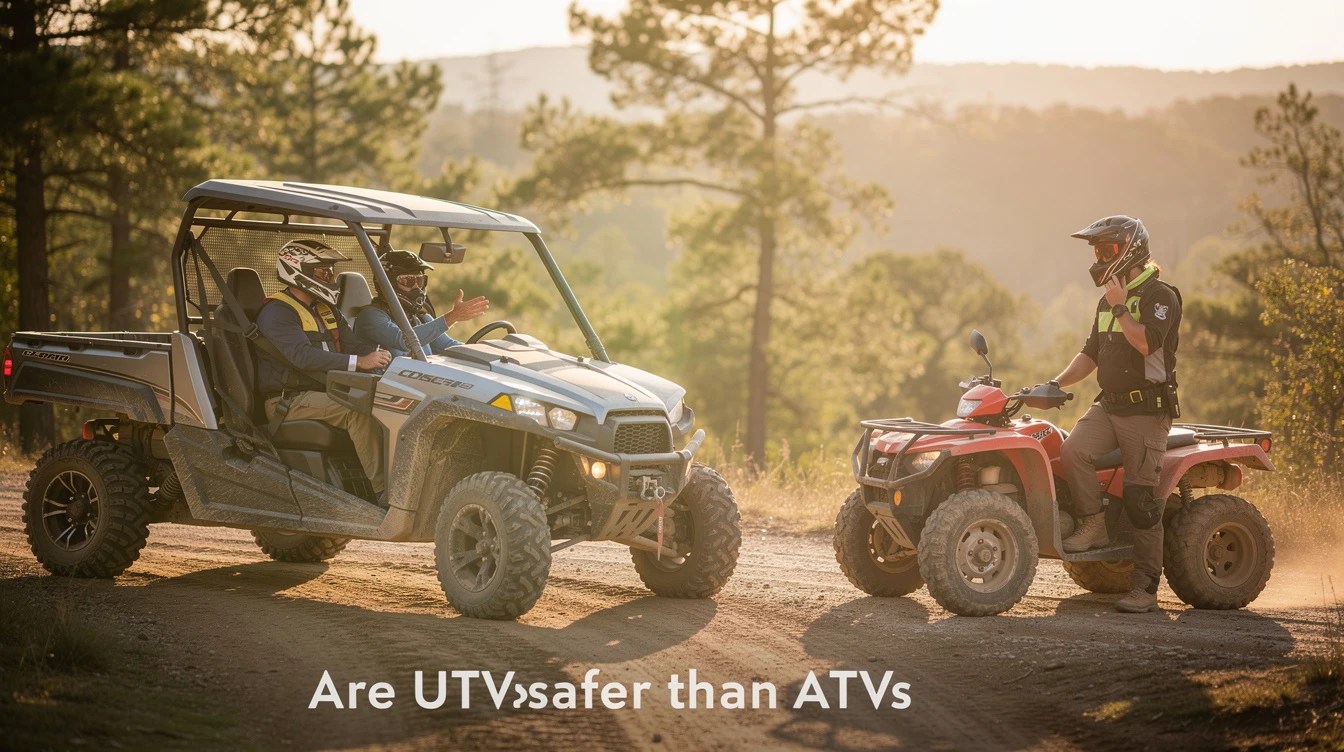
Yes, UTVs are significantly safer than ATVs. That is not opinion — it is engineering and data. UTVs have roll cages, seat belts, wider wheelbases, and lower centers of gravity. ATVs have none of those things. The result is exactly what you would expect: ATVs kill roughly 700 people per year in the United States according to the Consumer Product Safety Commission (CPSC), while UTV fatalities — though rising as the market grows — occur at dramatically lower rates per hour of use.
But "safer" does not mean "safe." UTVs have their own risk profile, and understanding the differences helps you make better decisions about which machine fits your needs, your terrain, and your family.
The Structural Safety Gap
The fundamental difference between a UTV and an ATV is occupant protection — and the gap is enormous.
| Safety Feature | UTV | ATV |
|---|---|---|
| Roll cage (ROPS) | Standard on all models | Not available |
| Seat belts | 3-point to 5-point harness | None |
| Side protection | Nets, half-doors, or full doors | None |
| Wheelbase width | 58–72 inches | 42–50 inches |
| Seating | Bucket seats with bolsters | Straddle seat |
| Steering | Automotive steering wheel | Handlebar |
| Passenger capacity | 2–6 with individual restraints | Single rider (no passengers recommended) |
| Rollover survivability | High (cage + belts) | Very low (no protection) |
The roll cage alone is the most significant safety difference. When a UTV rolls — and rollovers are the most common serious off-road accident — the cage creates a survival space. The occupant, held in place by the seat belt, stays inside that protected zone. When an ATV rolls, there is nothing between the rider and the ground except their body.
What the Fatality Data Shows
The CPSC has tracked ATV fatalities since the 1980s. The numbers are sobering:
- ATV deaths: Approximately 650–700 per year in the US (CPSC annual report)
- ATV injuries: An estimated 93,800 emergency department visits per year
- Children under 16: Account for roughly 25% of ATV fatalities
- Leading cause of death: Head injuries from ejection/rollover (no helmet and no cage)
UTV-specific fatality data is harder to isolate because the CPSC historically grouped them together. However, analysis by the Recreational Off-Highway Vehicle Association (ROHVA) and independent researchers shows that per-unit and per-hour fatality rates for UTVs are substantially lower than ATVs — even as UTV horsepower and speed capabilities have increased.
The key finding: the overwhelming majority of UTV fatalities involve unbuckled occupants who were ejected from the vehicle. When the restraint system is used correctly, the cage-and-belt combination prevents fatalities in most rollover scenarios. ATVs have no equivalent prevention mechanism.
Why ATVs Are Inherently Riskier
Active Rider Input Required
ATVs rely on the rider as a structural component of the vehicle. You shift your body weight to counterbalance turns, stand on the pegs over rough terrain, and use your arms and legs as dynamic suspension. This is called "active riding" and it works well — when the rider is skilled, sober, and not fatigued.
The problem is that active riding fails catastrophically. The moment a rider makes the wrong weight shift, gets caught by a hidden obstacle, or simply runs out of skill for the terrain, there is no backup system. No cage catches the mistake. No belt keeps them on the machine. The transition from "riding fine" to "serious accident" happens in a fraction of a second with no intermediate protection.
Passenger Risk
ATV manufacturers universally warn against carrying passengers on single-rider machines. The warnings are on every fender, in every manual, and in every safety course. And they are universally ignored. According to CPSC data, a significant percentage of ATV fatalities involve passengers on machines designed for one person — the passenger has nowhere to hold on securely, nowhere to put their feet safely, and no protection in any scenario.
UTVs eliminate this problem entirely. Every seating position has its own bucket seat, its own seat belt, and its own space within the roll cage. Carrying passengers in a UTV is a designed-in capability, not a dangerous improvisation.
Rollover Dynamics
ATVs have a narrower wheelbase and a higher center of gravity relative to their track width. They tip over more easily, especially on side slopes. Once an ATV begins to roll, the rider has about 0.3 seconds to react — which usually means trying to jump clear of a 500–800 pound machine tumbling at speed. Many riders do not clear the machine in time.
UTVs roll too — their higher speeds and heavier weight mean rollovers are still a real risk. But the wide wheelbase makes them harder to tip in the first place, and when they do roll, the cage and belts work as designed. The occupant stays in the seat while the cage takes the impact.
Where ATVs Still Make Sense
This is not an anti-ATV argument. ATVs have legitimate advantages in specific applications:
- Trail width: ATVs fit through single-track trails that no UTV can navigate. Their 42–50 inch width versus 58–72 inches means access to trails, tight timber, and narrow canyon passages that are physically impossible in a side-by-side.
- Weight: At 400–800 pounds, ATVs can go places where a 1,500–2,200 pound UTV would sink, break through, or be too heavy to recover.
- Agility: For experienced riders, the active riding dynamic provides more precise terrain negotiation at lower speeds — useful for technical rock crawling and steep hill climbs.
- Cost: Entry-level ATVs start around $5,000–$7,000 compared to $10,000–$15,000 for a comparable utility UTV. The total ownership cost including accessories, maintenance, and insurance reflects this gap.
- Storage and transport: An ATV fits in a short-bed truck or a small trailer. Most UTVs require a dedicated trailer.
Making Either Machine Safer
Regardless of which platform you choose, the same principles reduce risk:
For UTV Owners
- Always wear the seat belt. This is the single highest-impact safety action. Unbuckled UTV riders die at rates approaching ATV riders because they negate the cage protection through ejection.
- Wear a helmet. Even with a cage, head injuries from debris, branches, and interior impacts are real. Check your state helmet requirements — but wear one regardless of the law.
- Keep the doors/nets installed. They prevent arm extension during rollovers, which causes crush injuries.
- Do not exceed passenger capacity. Every extra body is an unrestrained projectile in a rollover.
- Maintain the machine. A solid maintenance schedule prevents mechanical failures that cause accidents — stuck throttle cables, worn brake pads, and loose steering components.
For ATV Owners
- Always wear a helmet. No cage means your helmet is the only head protection. DOT or Snell certified, every ride.
- Never carry passengers on a single-rider machine.
- Complete a safety course. Active riding skills are perishable and terrain-specific.
- Ride within your skill level. ATVs punish overconfidence immediately.
- Wear boots, gloves, and chest protection. Without a cage or doors, your body is exposed to everything.
The Street Legal Angle
One significant advantage UTVs have over ATVs: far more states allow UTVs to be made street legal. The built-in safety features (cage, belts, lights, mirrors) mean UTVs are closer to meeting DOT requirements for public road use. Most states do not offer any path to street-legalize an ATV.
If dual-purpose capability matters to you — trail riding AND road transport without a trailer — getting a UTV street legal opens up possibilities that ATVs simply cannot match.
Frequently Asked Questions
How many people die on ATVs each year?
The CPSC reports approximately 650–700 ATV-related fatalities per year in the United States. An additional estimated 93,800 ATV-related injuries result in emergency department visits annually. Children under 16 account for roughly 25% of fatalities.
Can a UTV roll over?
Yes. UTVs can and do roll over, especially at high speeds, on side slopes, and during aggressive cornering. The critical difference is that UTVs have roll cages and seat belts designed to protect occupants during a rollover. When properly restrained, occupants typically survive UTV rollovers with minor or no injuries.
Are UTVs safer for kids than ATVs?
Significantly. UTVs provide structural protection that ATVs completely lack. For families with younger riders, a UTV with proper restraints, a cage, and side nets eliminates the active-riding skill requirement that makes ATVs dangerous for inexperienced operators. Many youth-specific UTVs also include speed governors.
Why do people still buy ATVs if UTVs are safer?
ATVs cost less, fit on narrower trails, are lighter and easier to transport, and provide a different riding experience that many enthusiasts prefer. Safety is one factor in the purchase decision — trail access, budget, storage space, and riding style all play roles. ATVs are not inherently unsafe when used correctly by trained riders on appropriate terrain.
Do insurance companies charge more for ATVs than UTVs?
It varies by insurer, but many companies do charge higher liability premiums for ATVs than for comparable UTVs, reflecting the higher injury and fatality rates. Some insurers offer discounts for UTVs with factory ROPS and for operators who have completed approved safety courses.