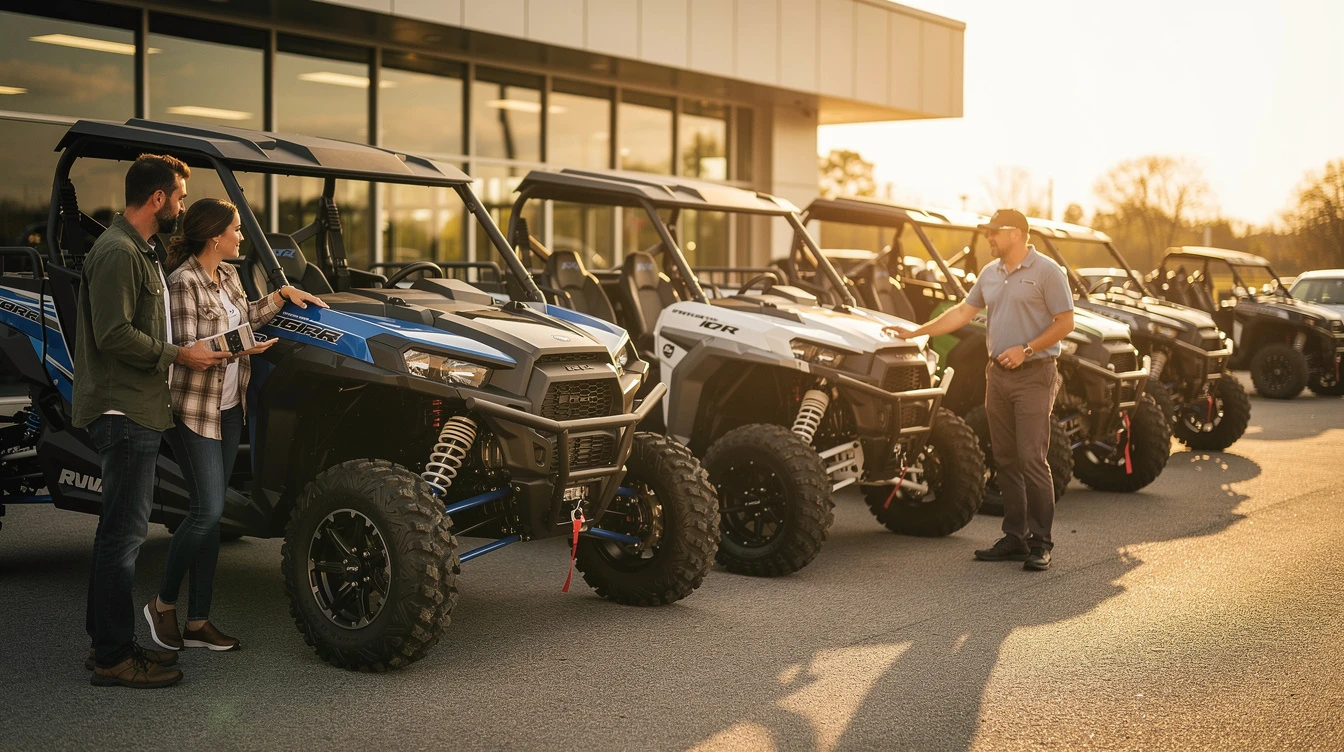
Walk into any powersports dealer and the sticker shock hits immediately. A mid-range Polaris RZR runs $22,000. A Can-Am Maverick X3 pushes past $30,000. Even a basic utility model like the Kawasaki Mule SX starts around $9,000 — and that is the cheap one. So what exactly makes these machines so expensive?
The short answer: UTVs pack truck-level engineering into a 1,500-pound chassis that has to survive desert whoops, rock gardens, and mud bogs. That combination of power, durability, and lightweight construction costs real money to design and build. But there is a lot more to the story than just "they are built tough."
The Engineering Behind UTV Prices
Modern UTVs are not glorified golf carts. They are purpose-built machines with technology that rivals — and sometimes exceeds — what you find in full-size trucks and sports cars.
Powertrain Complexity
Most sport and crossover UTVs run liquid-cooled engines producing 100–200+ horsepower. The 2026 Polaris RZR Pro R uses a 2.0L four-cylinder making 225 HP — that is supercar territory from a decade ago, crammed into a cage that weighs less than a Miata. These engines need custom-designed CVT transmissions, high-flow cooling systems, and exhaust setups that meet EPA noise and emissions standards while still performing at 10,000+ feet elevation.
Every one of those components is engineered specifically for the UTV application. Manufacturers cannot just pull a Corolla engine off the shelf. Low production volume means the per-unit cost of R&D stays high.
Suspension That Actually Works
A budget car gets MacPherson struts with maybe 6 inches of travel. A sport UTV like the RZR Turbo R gets 24+ inches of wheel travel with Walker Evans or FOX shocks featuring compression and rebound damping adjustable across multiple zones. These are not mass-produced commodity parts — they are co-developed with suspension companies specifically for each platform.
The front and rear A-arms, radius rods, and tie rods are made from forged or stamped high-strength steel. Some models use aluminum components to cut unsprung weight. All of this adds cost that simply does not exist in a standard automobile suspension.
Frame and Roll Cage
UTVs use ROPS (Roll Over Protective Structure) cages that have to pass NHTSA and OSHA standards. These are not just welded tubes — they are engineered crumple zones designed to protect occupants during rollovers at speed. The frame itself uses high-strength steel with specific flex characteristics so it absorbs trail impacts without cracking.
Material Costs Are Higher Than You Think
| Component | UTV Material | Car Equivalent | Cost Impact |
|---|---|---|---|
| Body Panels | Injection-molded HDPE plastic | Stamped steel | Higher per-unit tooling |
| Shocks | FOX/Walker Evans racing shocks | KYB/Monroe commodity struts | 5–10x more expensive |
| Axles | Heavy-duty CV joints rated for 200+ HP | Standard CV axles | 3–4x more expensive |
| Seats | Bolstered bucket seats with 4/5-point harnesses | Standard cloth seats with lap/shoulder belts | 2–3x more expensive |
| Tires | Specialty off-road (30–35 inch) | Highway all-season | 2x more expensive |
The body panels alone tell an interesting story. UTVs use thick injection-molded polyethylene because it flexes on impact instead of denting. That material is more forgiving on the trail, but the injection molds cost hundreds of thousands of dollars — and those costs spread across far fewer units than a Toyota Camry door panel.
Production Volume: The Biggest Hidden Factor
This is the factor most people overlook. Toyota sells roughly 300,000 Camrys per year in the US alone. Polaris sells about 100,000 total off-road vehicles across all models. When you narrow it down to a specific model like the RZR Pro XP, annual volume might be 10,000–15,000 units.
Low volume means:
- Higher per-unit R&D costs — the same engineering investment spreads across fewer machines
- Less supplier leverage — Polaris cannot negotiate the same parts prices as Ford
- Smaller factory runs — assembly line efficiency drops when you are not building 1,000 units per day
- Higher dealer margins — dealers need larger per-unit profit to stay viable with lower sales volume
According to discussions on r/SideBySide, many buyers do not realize that the UTV market is a fraction of the automotive market. The machines are priced where they need to be for manufacturers to stay profitable at these volumes.
The Accessory and Add-On Tax
Here is where the real cost creeps up. That $22,000 MSRP is just the starting point. Most owners spend an additional $3,000–$8,000 on accessories before they ever hit the trail:
- Windshield and roof: $300–$800
- Light bar: $200–$600
- Winch: $300–$700
- Doors and mirrors: $400–$1,200
- Bumpers: $300–$800
- Audio system: $500–$2,000
- Wheels and tires upgrade: $1,200–$3,000
Manufacturers know this, which is why some brands now offer "Ride Command" or premium trim packages that bundle popular accessories. You pay more upfront but typically save 15–20% versus buying each piece separately. If you are already investing in a UTV, understanding UTV maintenance costs helps you budget for the full ownership picture.
Are UTVs Worth the Money?
Compared to what? That is the real question. A loaded UTV costs about the same as a base-model economy car — but it does something completely different. Here is how the value equation breaks down:
Cost Per Hour of Use
Most UTV owners ride 50–150 hours per year. Over a 5-year ownership period at 100 hours annually, a $25,000 UTV breaks down to $50 per hour of use. Compare that to a $40,000 boat that might see 40 hours per year — that is $200 per hour over the same period. UTVs actually deliver strong value per hour of recreation compared to other powersports and outdoor toys.
Resale Value
UTVs hold their value better than most people expect. A well-maintained Polaris RZR typically retains 60–70% of its MSRP after three years, according to pricing data from NADA Guides. Limited-edition models and popular configurations sometimes hold even more. That beats the average car depreciation curve significantly.
Owners who properly maintain their machines and keep the hours reasonable see the best resale numbers. A UTV with 500 hours sells for meaningfully more than one with 2,000 hours — the market pays attention.
How to Get More UTV for Less Money
If the sticker price is giving you pause, there are legitimate ways to reduce the cost without sacrificing quality:
- Buy last year's model: Dealers discount outgoing models 10–20% to clear inventory. The mechanical differences between model years are usually minor.
- Consider the used market: A well-chosen used UTV at 200–400 hours can save you $5,000–$10,000 while still having most of its useful life ahead.
- Skip the top trim: The base model often shares the same frame, engine, and suspension architecture. The premium trim adds comfort features and cosmetics that you can add later.
- Bundle accessories at purchase: Negotiate a package deal on accessories when buying the machine. Dealers have more margin flexibility on parts and accessories than on the unit itself.
- Explore financing options: Manufacturer financing often runs 0–3.99% APR during promotional periods. Understanding UTV financing requirements upfront helps you lock in the best rate.
The Street Legal Factor
One way to maximize your UTV investment is making it street legal, which transforms it from a trail-only toy into genuine transportation. Instead of trailering your UTV to every riding spot, you can ride it from your driveway. That eliminates the need for a tow vehicle and trailer, which can save thousands.
The requirements for getting a UTV legal for public roads vary by state. Some states make it straightforward with a street legal kit, while others create bureaucratic roadblocks. Understanding the UTV laws in your state is the first step.
Frequently Asked Questions
Why are UTVs more expensive than ATVs?
UTVs require a full roll cage, two or more seats with restraint systems, a wider chassis, larger engine, and more complex suspension geometry. An ATV is essentially a motorcycle with four wheels — far simpler mechanically. The additional safety structures and passenger capacity in a UTV add $5,000–$15,000 in manufacturing cost over a comparable ATV.
Will UTV prices come down in the future?
Unlikely in a meaningful way. Raw material costs continue rising, emissions regulations add engineering complexity, and production volumes remain niche compared to automobiles. However, competition between Polaris, Can-Am, Honda, Yamaha, Kawasaki, and CFMOTO does keep pricing in check — no single manufacturer can dramatically outprice the market without cutting quality.
Are Chinese UTVs a cheaper alternative?
Brands like CFMOTO and Hisun offer UTVs at 30–50% lower MSRPs than Polaris or Can-Am. Build quality and reliability have improved significantly in recent years, and CFMOTO in particular has earned respect on forums like r/CFMOTO. The tradeoff is typically in ride quality, dealer support network, and resale value — but for budget-conscious buyers, they are worth considering.
How much does it cost to own a UTV per year?
Beyond the purchase price, expect $800–$2,000 per year in ownership costs: insurance ($200–$600), maintenance ($300–$800 for oil, filters, belts, and fluids), registration ($50–$200), and trail passes or land access fees. A good maintenance schedule keeps costs predictable and prevents expensive surprises.
Is financing a UTV worth it?
At promotional rates of 0–3.99% APR, financing often makes financial sense — especially if your alternative is depleting savings that earn more in a market account. The key is keeping the loan term to 48–60 months and putting at least 10–20% down so you are never underwater on the loan. Check current financing requirements before applying.