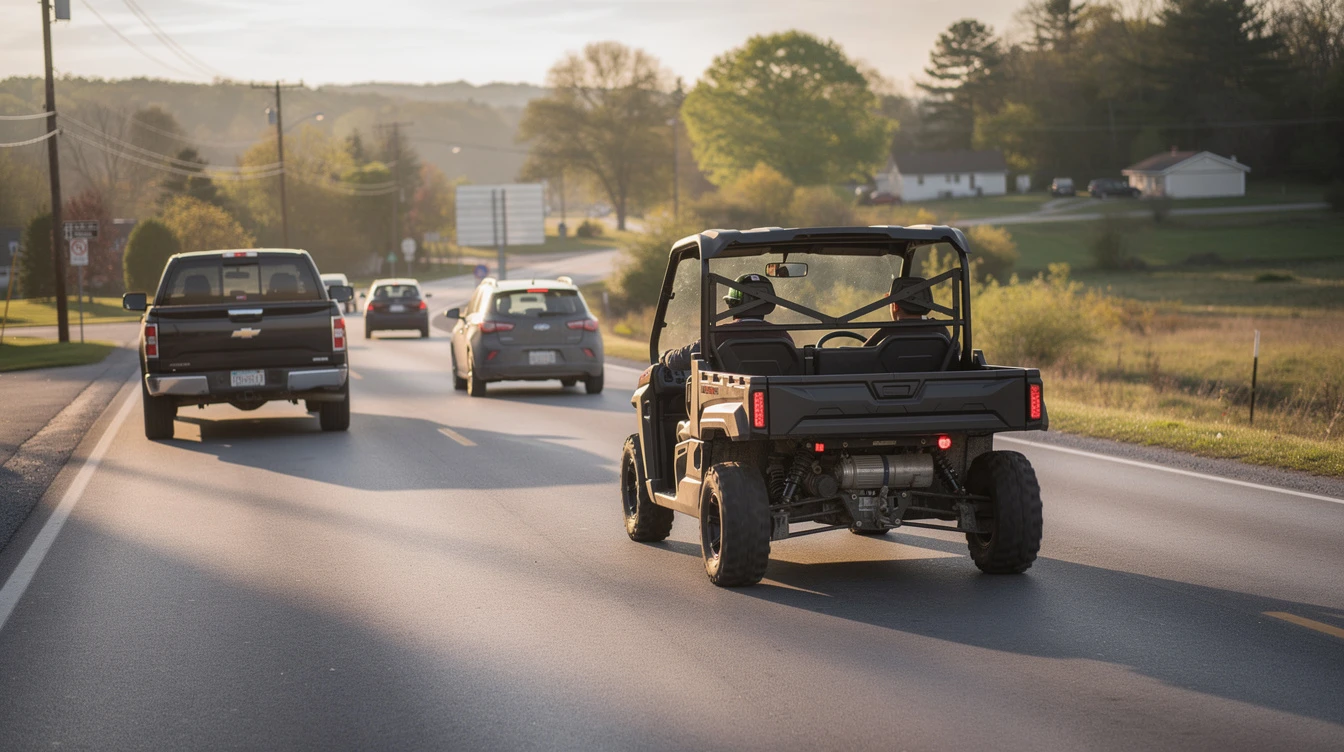
You can drive a UTV on public roads only if your vehicle is registered as street-legal, which usually requires specific safety equipment and a compliant registration status in your state of operation. Because most states do not classify UTVs as road-going vehicles by default, you must often work through an out-of-state registration process to obtain a valid plate and title that allows for legal pavement use.
Your UTV Needs Specific Equipment to Hit the Road
Most states have strict equipment requirements before they will recognize a UTV as a road-going vehicle. You cannot simply pull a side-by-side out of the woods and onto the highway without making sure it meets basic safety benchmarks. Law enforcement will look for specific hardware that separates a trail-ready machine from a street-ready one.
Generally, this includes functional headlights and taillights, brake lights, turn signals, mirrors, a horn, and often a windshield with wipers. If your UTV is missing these items, you are effectively restricted to private land or designated off-road areas. Many riders find that a UTV street legal kit provides the necessary components to bridge the gap between trail capability and road safety.
If you are trying to understand the baseline requirements for your specific machine, you should look at [How to Make a Side by Side Street Legal: What You Need, What It Costs, and How to Get It Done](https://streetlegalhookup.com/blog/how-to-make-a-side-by-side-street-legal). This guide breaks down the specific hardware hurdles you will face. Having the right parts installed is only half the battle, as the paperwork side of the house determines whether you can actually carry a valid registration.
Check My EligibilityHow Registration Processes Vary by State
The rules on whether a UTV can be on the road change drastically the moment you cross a state line. Some states have permissive laws for small-bore off-road vehicles on secondary roads, while others strictly forbid them regardless of your equipment. This is why many owners look to register through states with friendlier, more established procedures for powersports vehicles.
Ready to register your vehicle?
Join thousands of vehicle owners who use Street Legal Hookup to handle their registration quickly.
Get Street Legal →When you start the process, you are essentially asking a state agency to recognize your UTV as a motor vehicle. If your home state is hesitant, you might find that using an out-of-state filing service is the most efficient path forward. You can learn more about how this works for different vehicle types by reviewing [Everything You Need to Know About UTV Registration in Montana](https://streetlegalhookup.com/blog/utv-registration). Montana remains a popular option for many, as the state has clear, established frameworks for titling off-road assets.
It is important to remember that local ordinances often override state-level permissions. You might be compliant on a county road, but prohibited from entering a municipal street or a limited-access highway. Always check your local area after you have secured your registration documents.
The Role of Title Documentation in Your Success
You cannot effectively register your UTV without a clean title. If you bought your machine used and the previous owner lost the paperwork, you are in a difficult spot. DMV offices are notoriously rigid missing titles, and they will rarely make exceptions for off-road vehicles that were never intended to be titled for road use in the first place.
Many of our riders find that a bonded title or a secondary registration path is necessary to get things back on track. For those struggling with paperwork issues, [Getting a Title for a Bike With No Paperwork: Your Step-by-Step Guide](https://streetlegalhookup.com/blog/getting-a-title-for-a-bike-with-no-paperwork) covers the hurdles involved in reclaiming ownership status. Without a valid title, you cannot prove ownership, and you definitely cannot get a license plate issued.
If you are looking at how to get your UTV on the road, you should look at [How to Get Your UTV Street Legal for Public Roads](https://streetlegalhookup.com/blog/how-to-get-your-utv-street-legal-for-public-roads). This provides a more detailed roadmap of the steps required to go from off-road status to a registered, street-ready machine.
Registration Comparison and Workflow
Understanding the cost and the effort involved in making a UTV street-legal is the first step toward getting your keys in the ignition. Below is a breakdown of how the process typically looks for owners seeking out-of-state assistance versus dealing with local offices directly.
| Factor | Private Registration Assistance | Local DMV Office |
|---|---|---|
| Paperwork Support | End-to-end guidance | Self-managed |
| Efficiency | High, remote support | Variable, requires visit |
| Expertise | Powersports specialists | Generalists |
| Timeline | Efficient, reliable | Often delayed |
Common Roadblocks for UTV Owners
One of the biggest roadblocks is the VIN inspection requirement. Many states require that a physical inspector verify your VIN against the title before they issue plates. This is often where the system breaks down for UTV owners, as the original VIN might not be in the state database as a highway-legal vehicle. Using professional registration assistance can help you verify your eligibility before you sink money into parts that might not result in a plate.
Another issue is insurance. Even if you get a plate, many standard auto insurance companies will refuse to write a policy for a UTV on the street. You will need to find a carrier that specializes in off-road vehicles used on the road. Without proper coverage, even a registered vehicle can be towed by local law enforcement during a traffic stop.
If you are just getting started, you might want to look at [Street Legal Off Road Vehicle Requirements: What You Actually Need](https://streetlegalhookup.com/blog/street-legal-off-road-vehicle-requirements) to gain a better grasp of the technical and administrative requirements that come with this process.
Frequently Asked Questions
Can I drive my UTV on the highway?
In almost all cases, no. Even if you have a Montana registration, most states prohibit UTVs on high-speed interstates or highways due to speed limitations and stability concerns. Your registration usually permits you to ride on city streets and rural county roads, not interstate systems.
Do I need to visit my local DMV?
Not if you use private registration assistance. We manage the out-of-state paperwork with our paperwork support, so you do not have to deal with the frustration of local office visits or conflicting information from clerks who are not familiar with powersports conversions.
What if my UTV has no VIN?
A UTV without a VIN or with a damaged VIN is a significant obstacle. You will need to work with your state to obtain a state-assigned VIN before you can start any registration process. This is a manual, time-consuming process that must be resolved before any title work can begin.
Is a Montana LLC worth the cost for a UTV?
It depends on your goals. For owners with high-value vehicles or those who want to simplify the registration process across multiple states, a Montana LLC can offer significant advantages. You can learn more about this by reading [How Forming an LLC for Vehicle Registration Works for Your Assets](https://streetlegalhookup.com/blog/forming-llc-for-vehicle-registration).
How long does the conversion process take?
The timeline varies based on your paperwork status and the specific state where you are filing. Generally, once we receive your application and all required documents, we process your registration as efficiently as possible. Factors like backlogs at state agencies can impact the final delivery of your plates.
Getting your machine on the road requires patience and the right paperwork. If you are ready to stop guessing about your eligibility and start the process, we have the tools to help you succeed. We provide the support you need to work through these regulations without the corporate headaches.
Start My Conversion