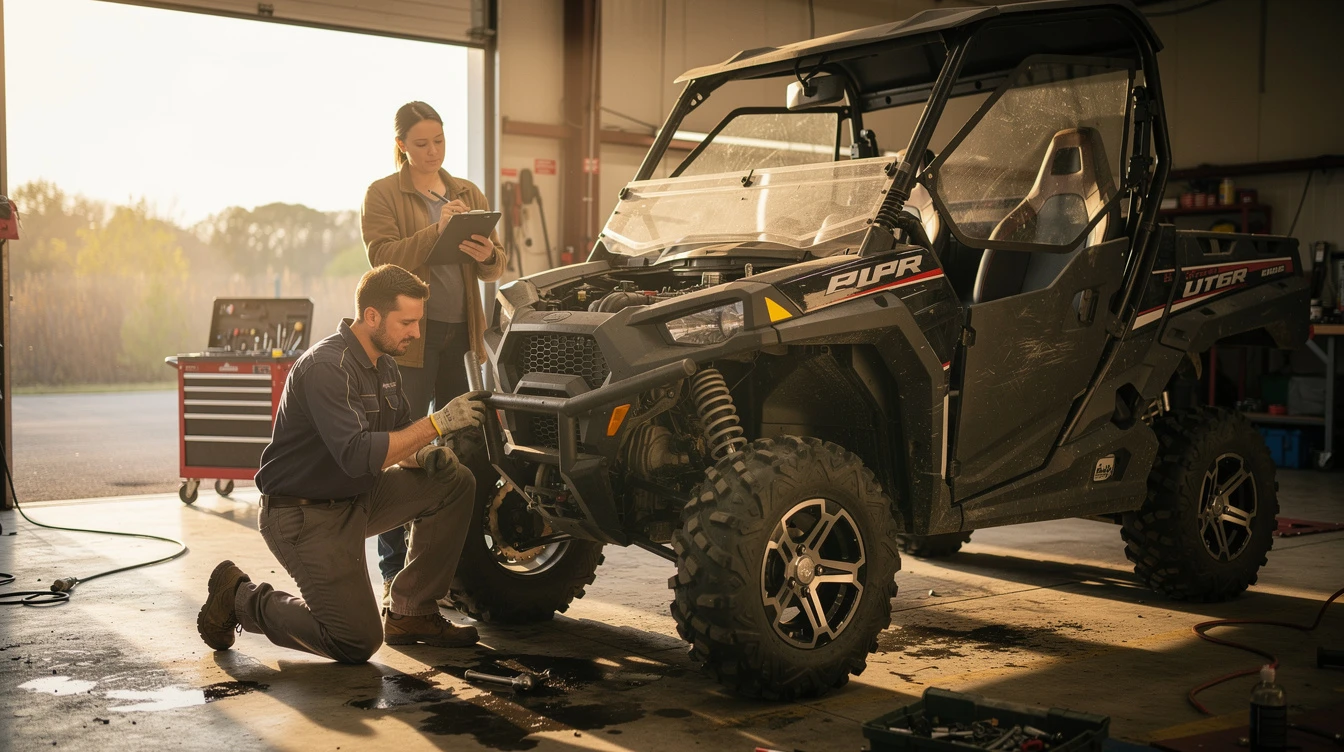
A UTV that gets regular maintenance runs better, lasts longer, and holds more value than one that gets ridden hard and ignored between rides. The problem is that most owners do not have a clear list of what to check and when. Your owner's manual has the information buried in 200 pages of legalese. This checklist distills it down to what actually matters, organized by interval so you can track it.
Before Every Ride (5-Minute Walk-Around)
These checks take less than five minutes and catch problems before they strand you on the trail or cause damage:
- Engine oil level: Check the dipstick with the engine cold and on level ground. Top off if low. If it is consistently low between changes, you have a leak or consumption issue to investigate.
- Coolant level: Check the overflow reservoir — it should be between the MIN and MAX marks. Never open the radiator cap when hot.
- Tire pressure: Run the manufacturer-recommended PSI for your riding conditions. Low pressure causes sidewall damage and affects handling. Over-inflation reduces traction and ride quality.
- Tire condition: Look for cuts, bulges, embedded rocks, and tread wear. Off-road tires take a beating — catch damage before it becomes a blowout.
- Brake fluid level: Check the reservoir on the master cylinder. Low fluid means worn brake pads or a leak in the system.
- Lights and signals: If your UTV is street-legal, check headlights, taillights, brake lights, and turn signals before every road ride.
- Loose bolts and fasteners: Vibration loosens bolts. Give the skid plates, bumpers, mirrors, and any aftermarket accessories a quick visual check.
After Every Muddy or Wet Ride
Mud and water create specific problems that do not apply to dry-condition riding. If you rode through mud, creek crossings, or standing water:
- Wash the machine: Focus on the radiator fins, engine bay, suspension components, and undercarriage. Mud left on metal holds moisture and causes rust. Mud packed in radiator fins causes overheating on the next ride.
- Grease all zerk fittings: Water displaces grease from ball joints, tie rod ends, and A-arm bushings. Fresh grease after a wet ride pushes water out and recoats the bearing surfaces.
- Check differential fluid: Pull the fill plug on the front and rear differentials. If the fluid is milky, gray, or has visible water, drain and replace it immediately. Water-contaminated differential fluid destroys gears within a few rides.
- Inspect the CVT intake and housing: Some UTVs pull water into the CVT housing through the intake snorkel. Water on the belt and clutch surfaces causes slipping and premature wear. Drain any water and dry the housing.
Every 500 Miles or 25-50 Hours
These are the regular maintenance items that keep components within their service life:
| Task | What to Do | Why It Matters |
|---|---|---|
| Air filter | Inspect, clean, or replace | A dirty filter restricts airflow, reduces power, and can let dirt past the filter into the engine |
| CVT belt | Inspect for cracks, glazing, and width | A worn belt slips, reduces performance, and can fail catastrophically |
| Grease fittings | Grease all zerks until fresh grease purges | Prevents premature ball joint and bearing failure |
| Brake pads | Inspect pad thickness | Running pads to metal damages rotors ($100+ per rotor vs. $20 per pad set) |
| CV boots | Inspect for tears or splits | A torn CV boot lets dirt into the joint, destroying it within a few rides |
| Wheel lug nuts | Check torque | Vibration loosens lug nuts. A loose wheel at speed is dangerous and damages the hub. |
Is your UTV properly registered?
Maintenance keeps your machine running. Registration keeps you road-ready. We can help with both.
Check My Eligibility →Every 1,000 Miles or 50-100 Hours (Major Service)
This is your major service interval. Schedule time for it — these tasks take 1 to 3 hours but prevent expensive failures:
Engine Oil and Filter Change
The most important maintenance task on any UTV. Drain the oil with the engine warm (warm oil flows better and carries more contaminants out). Replace the filter. Fill with the manufacturer-specified oil type and weight. Check the level on the dipstick after running the engine for 2 minutes.
Coolant System Check
Inspect hoses for cracks, swelling, or soft spots. Check hose clamps for tightness. If the coolant is more than 2 years old or looks discolored, flush the system and refill with fresh coolant mixed to the correct ratio (usually 50/50 coolant to distilled water).
Spark Plugs
Inspect and gap the spark plugs, or replace them. Fouled plugs cause hard starting, misfires, and reduced fuel efficiency. Most UTV spark plugs cost $5 to $15 each and take 15 minutes to replace.
Differential and Transmission Fluid
Check the level and condition of front differential, rear differential, and transmission fluid. Replace per the manufacturer's schedule, or immediately if the fluid is dark, burnt-smelling, or contaminated with water. Fresh fluid protects gears and bearings from wear.
Brake System
Inspect pad thickness on all four corners. Check rotors for scoring or warping. Bleed the brake lines if the pedal feels spongy — air in the lines reduces braking power. Replace brake fluid every 2 years regardless of mileage, as brake fluid absorbs moisture over time and loses effectiveness.
Every 2,000-3,000 Miles
- CVT belt replacement: Even if the belt looks okay, most manufacturers recommend replacement by 3,000 miles. A preventive swap is cheaper than a trail-side failure. Always carry a spare.
- Wheel bearings: Repack or replace wheel bearings. Symptoms of worn bearings include humming or grinding noise, wheel play, and uneven tire wear. Wheel bearing kits are $30 to $80 per corner.
- Suspension inspection: Check ball joints and tie rod ends for play. Replace worn components immediately — these are safety-critical. See our guide on common UTV problems for the inspection procedure.
Seasonal / Annual Maintenance
Start of Season
- Full fluid check and top-off (oil, coolant, brake, differential, power steering)
- Battery test and charge
- Belt inspection
- Tire pressure and condition
- All lights and signals (if street-legal)
- Registration and insurance verification — make sure both are current before the first ride
End of Season / Winter Storage
Follow our complete UTV winter storage guide, which covers fuel stabilization, oil change, battery removal, tire care, surface protection, and proper covering.
Maintenance Log — Track Everything
Keep a simple log of every maintenance task you perform. A notebook in the glovebox or a notes app on your phone works fine. Record the date, mileage/hours, and what you did. This serves three purposes:
- You never forget what is due. When did you last change the oil? When did the belt go in? The log tells you.
- You catch patterns. If you are adding coolant every 200 miles, you have a leak to find. The log reveals trends that single data points hide.
- Resale value. A documented maintenance history adds hundreds of dollars to your UTV's resale price. Buyers pay more for a machine they know has been cared for.
Frequently Asked Questions
How often should I change the oil in my UTV?
Most manufacturers recommend every 50 to 100 engine hours or every 500 to 1,000 miles, whichever comes first. If you ride in dusty or muddy conditions, err toward the shorter interval. Always use the oil weight and type specified in your owner's manual — UTV engines are sensitive to incorrect oil specifications.
What is the most important UTV maintenance task?
Oil changes. Nothing else comes close. Skipped oil changes are the number one killer of UTV engines. The engine oil protects bearings, cylinder walls, and cam surfaces. When it breaks down from heat, contamination, or age, metal-on-metal wear begins and accelerates rapidly. For the full picture on engine longevity, see how long UTVs last.
How often should I grease my UTV?
Grease all zerk fittings (A-arms, ball joints, tie rod ends, steering components) every 25 to 50 hours of use. After deep water crossings or heavy mud riding, grease immediately — water displaces grease from bearings and joints faster than normal riding. Pump grease until you see fresh grease purge from the fitting.
Do I need to check differential fluid on my UTV?
Yes. Check front and rear differential fluid levels every 500 miles. Change the fluid every 1,000 to 2,000 miles or immediately after any deep water crossing. Water intrusion into differentials destroys gears and bearings quickly. The fluid should be clean and translucent — milky or gray fluid means water contamination and requires immediate replacement.
How do I know when my CVT belt needs replacement?
Signs include: burning rubber smell during or after rides, reduced top speed, sluggish acceleration, visible cracking or glazing on the belt surface, and excessive belt dust in the CVT housing. Most belts last 1,500 to 3,000 miles depending on riding style. When in doubt, measure the belt width — if it is narrower than spec, replace it.
Want to make your UTV street-legal? Start here →