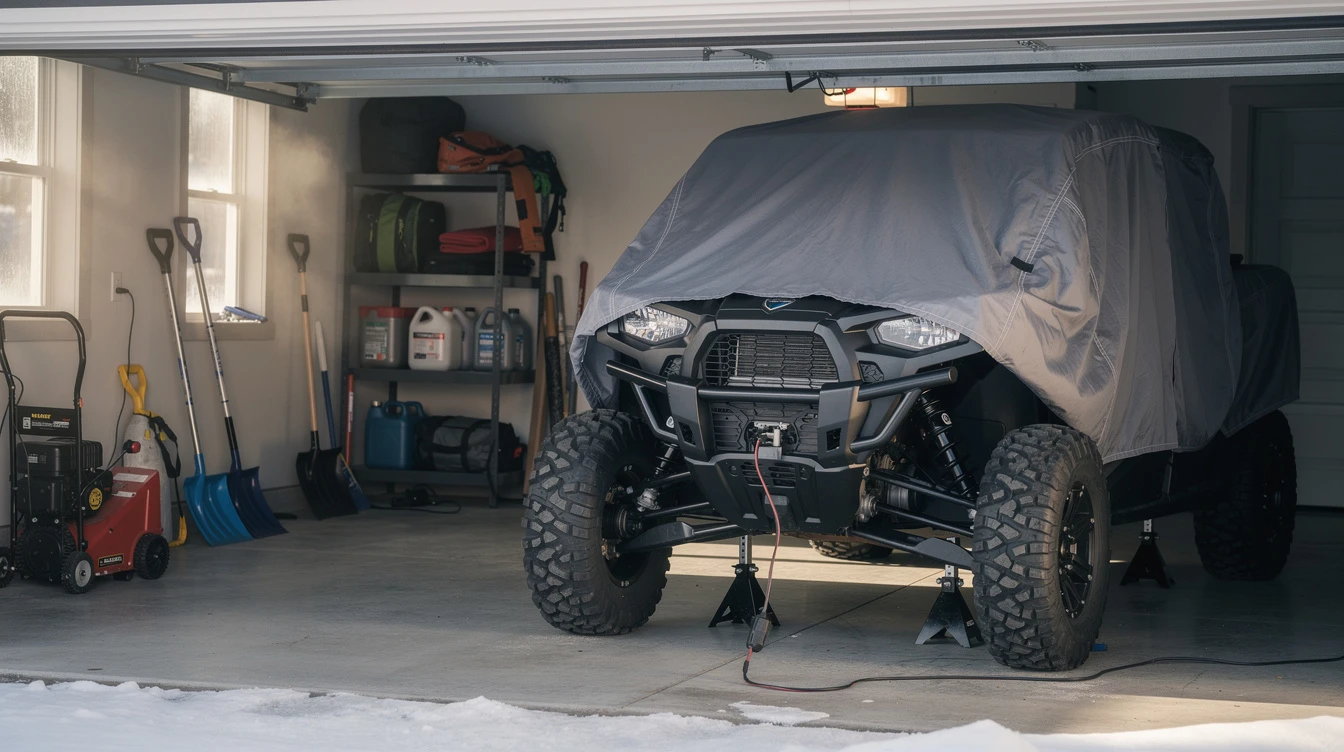
Winter is coming and your UTV is about to sit for three to five months. How you prep it for storage determines whether it fires right up in spring or greets you with a dead battery, gummed-up fuel system, and flat-spotted tires. These six steps take about two hours and will save you hundreds in spring repairs. Do them all — skipping one creates the exact problem it was designed to prevent.
Step 1: Stabilize the Fuel System
Untreated gasoline starts breaking down within 30 days. After 60 to 90 days, it forms varnish and gum that clog carburetors, foul injectors, and coat fuel lines. By the time you pull the machine out in April, you are looking at a fuel system cleaning or rebuild.
The fix is simple:
- Fill the tank to about 95% full — this minimizes the air space where condensation forms
- Add fuel stabilizer (Sta-Bil, Sea Foam, or equivalent) at the ratio specified on the bottle
- Run the engine for 5 to 10 minutes so treated fuel reaches the carburetor or injectors, fuel rail, and lines
- Shut it down — the treated fuel now sits in every part of the system, protecting against varnish buildup
Do not drain the fuel system instead. An empty tank and empty fuel lines invite condensation, which causes rust in steel tanks and corrosion in fuel components. Treated fuel in a full tank is the safer approach every time.
Step 2: Change the Oil and Filter
This is the step people skip because "I'll just change it in spring." That is backwards. Used oil contains acids, moisture, and combustion byproducts that sit against your engine's bearings, cylinder walls, and cam surfaces for months. Fresh oil has a full additive package that actively protects against corrosion during storage.
- Run the engine until it reaches operating temperature — warm oil drains more completely and carries more contaminants out
- Drain the old oil and replace the filter
- Fill with the manufacturer-recommended oil weight and quantity
- Run the engine for 2 minutes to circulate fresh oil through the entire system
This is also a good time to check your coolant. If it has been more than two years or the coolant looks discolored, flush and replace it. Coolant loses its anti-corrosion properties over time, and a winter of sitting with degraded coolant can eat aluminum components from the inside out. For more on keeping your UTV in shape, see our UTV maintenance checklist.
Step 3: Handle the Battery
A UTV battery connected to the machine will slowly discharge through the electronics — clock, ECU, alarm system — even when the key is off. After 60 to 90 days, it is dead. After 120+ days, it may be permanently sulfated and need replacement ($80 to $200 depending on the machine).
Your options, ranked from best to acceptable:
- Best: Remove the battery, bring it indoors, and connect it to a smart battery tender (Battery Tender Jr., NOCO Genius, etc.). The tender maintains full charge without overcharging.
- Good: Disconnect the negative terminal and leave the battery in the machine. It will self-discharge slowly but should survive 3 to 4 months in moderate temperatures.
- Acceptable: Leave the battery connected but attach a trickle charger that can reach the machine in its storage location. Solar-powered tenders work for outdoor storage.
Never store a lead-acid battery on a concrete floor — the cold accelerates discharge. Set it on a wood shelf or rubber mat if storing indoors.
While your UTV is parked, get your registration sorted
Winter is the perfect time to handle registration, titling, or LLC formation so your rig is ready for spring.
Check My Eligibility →Step 4: Protect the Tires
Tires sitting in the same position for months develop flat spots — areas where the rubber deforms under the weight of the machine. On UTVs with aggressive off-road tires, flat spots can cause vibration and uneven wear that persists for hundreds of miles after you start riding again.
Prevention:
- Inflate tires to the maximum sidewall pressure (not the riding pressure — the max listed on the tire). Higher pressure resists flat spotting. You will re-set to riding pressure in spring.
- If possible, get the tires off the ground. Jack stands under the frame or axles eliminate the weight that causes flat spots entirely. This is the gold standard for long-term storage.
- If you cannot lift it, place plywood under each tire. The wood distributes the weight and insulates the rubber from cold concrete, which makes flat spotting worse.
- Move the machine a few inches every 4 to 6 weeks if you can. Even a small roll shifts the contact patch and prevents permanent deformation.
Step 5: Clean and Protect Surfaces
Dirt, mud, and trail grime are not just ugly — they trap moisture against metal, plastic, and rubber surfaces. Over a winter of storage, that trapped moisture causes rust on exposed steel, mildew on seats, and corrosion on electrical connectors.
- Wash the entire machine — undercarriage, suspension, engine bay, and body panels. A pressure washer works, but avoid direct high-pressure spray on bearings, electrical connectors, and the air intake.
- Dry it completely. Water left in crevices defeats the purpose of washing. Run the engine briefly after washing to evaporate moisture from the exhaust and engine bay.
- Spray exposed metal surfaces (frame, suspension, hitch, etc.) with a light coat of WD-40 or a dedicated corrosion inhibitor
- Treat plastic and rubber — a UV protectant like 303 Aerospace on plastics and a silicone-based product on rubber seals prevents cracking and drying
- Condition the seats if they are vinyl or leather. A marine-grade vinyl protectant works well for UTV seats that take weather abuse.
Step 6: Cover and Store Properly
Where and how you store the machine matters almost as much as the prep work:
Indoor Storage (Best)
A garage, barn, or enclosed building with a concrete floor is ideal. The roof protects from precipitation and UV, the walls buffer temperature swings, and the floor keeps the tires off bare dirt. If rodents are a concern — and they should be, because mice love chewing UTV wiring — stuff steel wool into the exhaust outlet and air intake, and place mothballs or rodent deterrent packets around the machine.
Outdoor Storage (Acceptable)
If you must store outside, invest in a quality fitted UTV cover — not a generic tarp. A proper cover:
- Is breathable (prevents condensation buildup underneath)
- Fits snugly so wind does not whip it against the paint and plastics
- Has UV protection built into the fabric
- Includes tie-downs or an elastic hem to stay in place during storms
Park on gravel or pavement, not bare dirt or grass. Moisture wicking up from the ground accelerates corrosion and tire degradation.
Spring Startup Checklist
When the snow melts and it is time to ride, do not just crank it and go. Run through this quick checklist:
- Reconnect or reinstall the battery
- Check tire pressures and reset to riding PSI
- Inspect belts (CVT drive belt especially) for cracking or glazing
- Check all fluid levels — oil, coolant, brake fluid
- Inspect brake pads and rotors for rust buildup
- Remove any rodent deterrents from exhaust and intake
- Start the engine and let it reach full operating temperature before riding
- Test brakes, steering, throttle response, and 4WD engagement at low speed before hitting the trail
If you followed all six storage steps, this checklist should take 15 minutes and your machine should be ready to ride. For more on keeping your UTV running right, check out our guides on common UTV problems and fixes and how long UTVs last with proper care.
Frequently Asked Questions
Should I start my UTV during winter storage?
It is better not to. Starting the engine briefly without reaching full operating temperature creates condensation inside the engine and exhaust, which causes more corrosion than leaving it parked. Riders on Reddit's r/UTV have confirmed this — short runs during storage do more harm than good. If you properly stabilized the fuel and disconnected the battery, the machine will be fine sitting for 3 to 5 months.
Do I need to change the oil before winter storage?
Yes. Used oil contains acids, moisture, and combustion byproducts that corrode engine internals over months of sitting. Fresh oil protects bearings, cylinder walls, and other components during extended storage. Change the oil and filter before you park it — not in spring when the damage is already done.
Can I store my UTV outside in winter?
You can, but it is not ideal. UV exposure, rain, snow, and temperature swings accelerate wear on plastics, seats, belts, and electrical connectors. If you must store outside, use a heavy-duty fitted cover designed for UTVs and elevate the machine off bare ground. Indoor storage in a garage or barn is always the better choice.
How long does fuel stabilizer keep gas fresh?
Most fuel stabilizers like Sta-Bil and Sea Foam protect fuel for 12 to 24 months when used at the correct ratio. For typical winter storage of 3 to 5 months, any quality stabilizer will keep your fuel from gumming up the carburetor or injectors. Follow the dosage instructions on the bottle — more is not better.
Should I remove the battery during winter storage?
Removing the battery or at minimum disconnecting the negative terminal is strongly recommended. A connected battery slowly drains through the machine's electronics and can die or sulfate permanently over a few months. Store the battery indoors on a trickle charger or battery tender for the best results.
Need to get your UTV street-legal before spring? Start here →