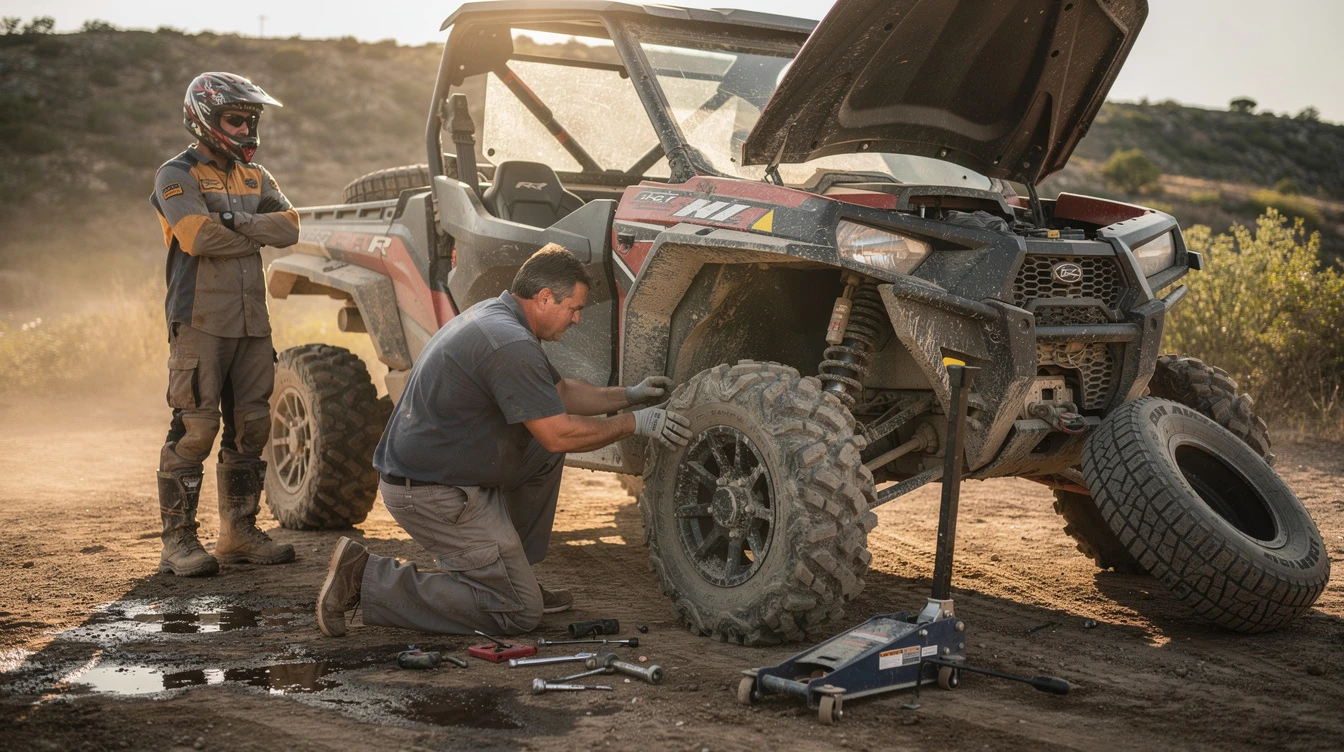
UTVs are built tough, but they are not bulletproof. These machines get hammered on trails, pushed through mud, bounced over rocks, and then parked covered in dirt until the next weekend. That kind of use creates a predictable set of problems that every side-by-side owner will eventually face. Here are the most common UTV issues, what causes them, and how to fix them before they leave you stranded on the trail.
1. Overheating
Overheating is the single most common UTV complaint, and it happens for a simple reason: UTVs run at high RPM and low speed in conditions that starve the cooling system of airflow. Your truck cruises at 60 mph and gets plenty of air through the radiator. Your UTV crawls at 5 mph through a mud pit and gets none.
Common Causes
- Clogged radiator: Mud, dust, bugs, and debris pack into the radiator fins and block airflow. This is the #1 cause and the easiest to fix.
- Low coolant: Leaks at hose clamps, the water pump seal, or the radiator cap allow coolant to escape slowly. You do not notice until the temp gauge spikes.
- Failed thermostat: A stuck-closed thermostat prevents coolant from reaching the radiator. The engine overheats fast.
- Air in the system: After a coolant change or leak repair, trapped air pockets prevent proper circulation.
- Blown head gasket: The nuclear option. Exhaust gases leak into the cooling system, displacing coolant and creating hot spots. You will see white smoke from the exhaust, milky oil, or bubbling in the coolant overflow tank.
Fixes
- Clean the radiator after every muddy ride — a garden hose and gentle brush work. Do not use high-pressure wash directly on the fins; it bends them.
- Check coolant level before every ride. Top off with the manufacturer-recommended coolant type (not straight water).
- Consider a radiator relocation kit if you ride in heavy mud. Moving the radiator to the roof or behind the cab keeps it cleaner. Polaris RZR, Can-Am Maverick, and Yamaha Wolverine all have aftermarket relocation options.
Riders on r/UTV consistently rank radiator relocation as the single best modification for mud riders. It virtually eliminates overheating in deep-mud conditions.
2. CVT Belt Failures
The continuously variable transmission (CVT) belt is the link between your engine and your wheels. When it breaks, you are going nowhere. When it wears, you lose power, speed, and throttle response.
Signs of Belt Wear
- Burning rubber smell during or after rides
- Loss of top speed or sluggish acceleration
- Visible cracking, glazing, or fraying on the belt surface
- Belt dust accumulating in the CVT housing
- Squealing or chirping noise under load
Belt Lifespan
Most CVT belts last 1,500 to 3,000 miles, but riding style matters enormously:
| Riding Style | Expected Belt Life |
|---|---|
| Trail riding (moderate) | 2,500 – 3,000+ miles |
| Mud riding (heavy load, low speed) | 1,000 – 2,000 miles |
| Dune riding (high RPM, sand drag) | 1,500 – 2,500 miles |
| Rock crawling (heavy clutch engagement) | 1,500 – 2,000 miles |
| Utility/farm work (towing, hauling) | 2,000 – 3,000 miles |
Always carry a spare belt. A belt change on the trail takes 15 to 30 minutes with basic tools. A broken belt without a spare means a tow or a long walk. For more on keeping your belt and drivetrain healthy, see our UTV maintenance checklist.
3. Power Steering Failures
Electric power steering (EPS) has become standard on most UTVs, and when it fails, you know immediately. The steering goes heavy — especially at low speed — and turning becomes a workout.
Common Causes
- EPS motor failure: The electric motor that assists steering wears out over time or fails from water intrusion
- Wiring harness damage: Rocks, branches, and trail debris can damage the wiring to the EPS unit
- Faulty EPS controller: The electronic module that manages steering assist can fail, especially after voltage spikes
- Blown fuse: The simplest cause and the first thing to check. A blown EPS fuse kills power steering instantly.
EPS repairs range from $0 (fuse replacement) to $500+ (motor or controller replacement). Check the fuse first, then inspect the wiring harness for visible damage before assuming the motor is dead.
4. Electrical Gremlins
UTVs and water do not mix well electrically. Every creek crossing, mud hole, and rainstorm exposes connectors, switches, and wiring to moisture. Over time, this creates a category of problems riders call "electrical gremlins" — intermittent failures, random warning lights, accessories that work sometimes, and gauges that read wrong.
Most Common Electrical Issues
- Corroded connectors: Green or white buildup on connector pins causes resistance, voltage drops, and intermittent contact
- Failed switches: Ignition switches, 4WD selectors, and diff lock switches get water inside and corrode internally
- Battery drain: Aftermarket accessories (light bars, winches, stereos) wired without proper relays drain the battery overnight
- Ground faults: A corroded or loose ground wire causes cascading electrical problems that look like multiple unrelated failures
Prevention and Fixes
- Apply dielectric grease to every electrical connector you can access. It displaces water and prevents corrosion. Do this annually or after heavy water exposure.
- Use marine-grade connectors and heat-shrink for any aftermarket wiring. Standard crimp connectors corrode within a season in wet conditions.
- Check and clean ground connections annually. Most UTVs have one or two main ground points on the frame — clean them to bare metal and apply anti-corrosion compound.
Is your UTV street-legal?
Many states allow UTVs on public roads with the right equipment and registration. Find out if yours qualifies.
Check My Eligibility →5. Fuel System Issues
Fuel problems show up as hard starting, rough idle, loss of power, or stalling. The usual suspects:
- Stale fuel: Gas left sitting for 60+ days without stabilizer breaks down, gums up injectors and carburetors, and clogs filters. This is the #1 fuel problem and is completely preventable. See our winter storage guide for the fix.
- Clogged fuel filter: Dust and debris make it past the fuel cap seal and settle in the tank. The filter catches them, but eventually it restricts flow.
- Water in fuel: Condensation in the tank or contaminated gas from a sketchy fuel pump puts water in your fuel system. Symptoms include sputtering, misfires, and stalling.
- Failing fuel pump: Fuel pumps in UTVs are not as robust as automotive units. Symptoms include loss of power under load, hard starting when hot, and a whining noise from the fuel tank area.
6. Suspension and Steering Wear
UTVs take enormous suspension abuse. Rocks, ruts, jumps, and washboard trails pound ball joints, tie rod ends, bushings, and shocks at a rate that would destroy a car in weeks.
What to Inspect Regularly
- Ball joints: Jack up the front end and grab the tire at 12 and 6 o'clock. Rock it — any play means worn ball joints. These are safety-critical; do not ride with worn ball joints.
- Tie rod ends: Grab the tire at 3 and 9 o'clock and rock it. Play here indicates worn tie rod ends, which affect steering precision and alignment.
- A-arm bushings: Cracked or worn bushings allow the A-arms to move in ways they should not, causing clunking, wandering steering, and accelerated tire wear.
- Shocks: Look for oil leaking from the shock body. A leaking shock has lost its damping ability and will bottom out or bounce excessively.
Most of these components are serviceable at home with basic tools. Ball joints and tie rod ends run $20 to $60 per piece and take 30 minutes to an hour per side. Catching them early prevents cascading damage to other components.
7. Clutch and Drivetrain Noise
Clicking, clunking, or grinding from the drivetrain usually points to one of these:
- Worn CV joints/boots: Clicking during turns is the classic sign. If the CV boot has torn, dirt has contaminated the joint and it needs replacement.
- Loose or worn wheel bearings: A humming or grinding noise that changes with speed. Jack up the wheel and check for play.
- Differential issues: Clunking when shifting between 2WD and 4WD, or grinding under load, can indicate worn differential gears or low fluid.
When to Fix vs. When to Replace
The question every UTV owner faces eventually: is this machine worth fixing?
As a general rule, if the frame is straight and the engine and transmission are sound, almost any other problem is fixable for far less than a new UTV costs. A $200 ball joint replacement or $150 CVT belt swap beats a $15,000 to $30,000 new machine. See our breakdown of why UTVs are so expensive and new vs. used UTV pros and cons to help make the call.
Frequently Asked Questions
Why does my UTV keep overheating?
The most common causes are a clogged radiator (mud, debris, bugs), low coolant, a failed thermostat, or a blown head gasket. UTVs overheat more than cars because they run hard at low speeds in dusty conditions with small radiators. Clean the radiator fins after every muddy ride and check coolant levels regularly.
How often should I replace the CVT belt on my UTV?
Most CVT belts last 1,500 to 3,000 miles depending on riding style and conditions. Aggressive riding, heavy loads, deep mud, and steep hill climbing all accelerate belt wear. Carry a spare belt on every ride — a broken belt leaves you stranded with no way to move under your own power.
Why does my UTV lose power going uphill?
Common causes include a worn CVT belt that is slipping, a dirty air filter restricting airflow, a clogged fuel filter, fouled spark plugs, or exhaust restrictions. Start with the air filter and belt — these are the most frequent culprits and the easiest to check in the field.
What causes UTV electrical problems?
Water intrusion into connectors is the number one cause. UTVs get submerged in mud and creek crossings regularly, and water in electrical connectors causes corrosion, shorts, and intermittent failures. Aftermarket accessories wired incorrectly are the second most common cause — always use proper relays and marine-grade connectors.
Is it worth fixing an older UTV or should I buy new?
If the frame, engine block, and transmission are solid, most UTV problems are fixable for $200 to $1,500. A new UTV costs $10,000 to $30,000+. The math usually favors repair unless you are looking at a cracked frame or seized engine. Check our new vs. used UTV comparison for a full cost breakdown.
Want to make your UTV street-legal? See your options →