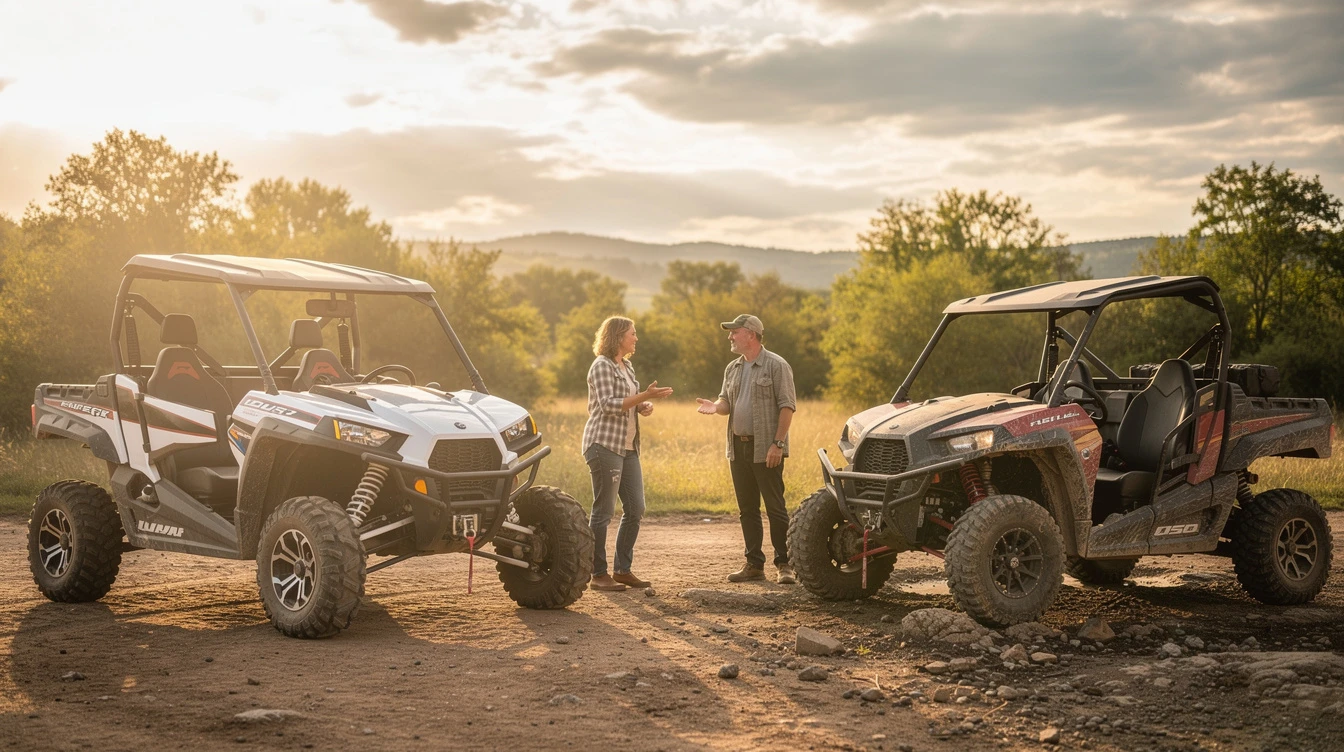
The new-versus-used debate splits every UTV forum on the internet. One camp says new machines come with a warranty, zero problems, and the latest tech. The other camp says you are throwing away $5,000–$10,000 in depreciation the moment you sign the paperwork. Both are right — and both are wrong — because the answer depends entirely on how you ride, how much you wrench, and what you can actually afford.
Here is an honest breakdown of both sides, with real numbers instead of opinions.
New UTV: What You Actually Get
The Advantages
Factory warranty. This is the headline benefit. Most manufacturers offer 6-month to 2-year warranties (Polaris and Can-Am offer 1 year standard, Honda offers 1 year, Yamaha offers limited warranties up to 10 years on certain belt components). A factory warranty covers defects in materials and workmanship — meaning if the engine drops a valve or the transmission fails through no fault of your own, the dealer fixes it at no charge.
Zero maintenance history risk. A new UTV has never been beaten on a desert race course by a previous owner who claimed it was "lightly used on weekends." You know exactly how it has been broken in, maintained, and stored — because you are the one doing it.
Latest technology. Ride Command touchscreens, electronic power steering refinements, improved CVT belt designs, updated suspension tuning — each model year brings incremental improvements that a 3-year-old used model will not have. The 2026 Polaris RZR platform, for example, has meaningfully better belt cooling and clutch calibration than the 2023 version.
Financing availability. Manufacturers run promotional financing (0%–3.99% APR) on new inventory that is rarely available on used units. If you plan to finance, understanding current financing requirements helps you compare the true cost of new vs. used money.
Full customization. Starting fresh means every accessory, every modification, and every protection product goes on the way you want it. No inheriting someone else's questionable wiring job or misaligned light bar.
The Disadvantages
Depreciation is steep. A new UTV loses 15–25% of its value the first year and another 10–15% the second year. On a $25,000 machine, that is $3,750–$6,250 gone in year one alone. This is the largest cost of new ownership and it is completely invisible — you only feel it when you sell or trade.
Higher insurance premiums. Full coverage on a new UTV costs more than on a used one. Expect $400–$800 per year for comprehensive coverage on a new sport UTV.
Dealer markup and fees. Freight ($500–$1,000), setup/assembly ($300–$700), and dealer documentation fees ($100–$300) add $1,000–$2,000 to the sticker price that have zero resale value.
Used UTV: What You Actually Get
The Advantages
Someone else ate the depreciation. A 2–3 year old UTV with 200–500 hours typically sells for 60–75% of its original MSRP. On that same $25,000 machine, you are buying in at $15,000–$18,750. That is real money — enough to buy a quality trailer and a full set of accessories.
Known reliability data. When a model has been out for 2–3 years, the community knows its weak points. Forum threads, Reddit discussions on r/SideBySide, and YouTube teardowns reveal which clutch kits fail, which axles snap, and which electrical gremlins appear at what mileage. You can make an informed decision instead of being a beta tester.
Lower insurance costs. Agreed value and actual cash value on a used UTV means lower premiums — sometimes 20–30% less than the same model new.
More machine for your budget. The used market lets you step up a category. If your new budget is $15,000 (base utility model), your used budget at the same price point gets you a 2–3 year old sport or crossover model with more power, better suspension, and more capability.
The Disadvantages
Unknown history. This is the biggest risk. Was it trail ridden gently by a 55-year-old on weekends? Or was it hammered through King of the Hammers qualifying by a 22-year-old who never changed the oil? Hour meters can be reset. Maintenance records can be fabricated. Some sellers are honest — some are not.
No warranty (usually). Factory warranties typically do not transfer, or transfer with restrictions. You can buy third-party extended warranties, but they come with exclusions, deductibles, and claim hassles that factory coverage does not.
Deferred maintenance costs. The "great deal" at $14,000 becomes less great when it needs a $2,800 clutch rebuild, $1,200 in bushings, and a $600 belt at 400 hours. Budget $1,000–$3,000 for immediate maintenance on any used UTV — assume the previous owner deferred something.
The Numbers: New vs. Used Total Cost of Ownership
| Cost Category | New ($25,000 MSRP) | Used ($16,000 / 3 yrs old) |
|---|---|---|
| Purchase price | $25,000 | $16,000 |
| Dealer fees (freight/setup/doc) | $1,500 | $0 |
| Sales tax (est. 7%) | $1,750 | $1,120 |
| Immediate maintenance/repair | $0 | $2,000 |
| Insurance (3 years) | $1,800 | $1,200 |
| Routine maintenance (3 years) | $1,500 | $2,200 |
| Resale value after 3 years | –$16,250 | –$11,200 |
| Net 3-Year Cost | $15,300 | $11,320 |
The used UTV saves roughly $4,000 over three years of ownership in this scenario. But that savings comes with more risk, more uncertainty, and more time spent researching and inspecting. For some buyers, the peace of mind of new is worth $4,000. For others, that $4,000 buys a lot of accessories and trail trips.
How to Buy a Used UTV Without Getting Burned
If you go the used route, these steps protect you from the most common problems:
- Check the hour meter first. Under 300 hours is lightly used. 300–800 hours is moderate. Over 1,000 hours means significant wear on clutch, suspension, and drivetrain components. Be skeptical of low hours with heavy cosmetic damage — that is usually a reset.
- Pull the air filter and check the CVT intake. A clean airbox suggests maintenance discipline. A filter packed with dust or a CVT clutch cover full of belt dust suggests neglect.
- Inspect all four axle boots. Torn CV boots mean dirt ingression, which means the axle is dying. Budget $400–$800 per axle replacement.
- Test the belt. Remove the CVT cover and measure belt width. Compare to the new-belt specification. A belt under spec needs replacement ($150–$300) and tells you the owner was not proactive about maintenance.
- Check the frame for cracks. Look at A-arm mounts, radius rod mounts, and cage mount welds. Cracks here mean the machine has been beaten hard or rolled. Walk away.
- Get a realistic lifespan expectation for the model you are considering. Some machines are good for 5,000+ hours with proper care. Others have known issues at 1,500.
The Third Option: Certified Pre-Owned
Both Polaris and Can-Am offer certified pre-owned (CPO) programs through participating dealers. CPO units get a multi-point inspection, any needed repairs, and a limited warranty extension. You pay more than private-party used pricing but less than new — typically 75–85% of current MSRP for a 1–2 year old model with under 200 hours.
CPO is the middle ground that makes sense for buyers who want used pricing with some new-buyer protection. The warranty is not as comprehensive as a factory warranty on a new unit, but it covers the major systems that cause expensive surprises.
Street Legal Considerations for New and Used
Whether you buy new or used, getting your UTV registered for road use requires proper titling and documentation. New UTVs come with a clean MSO (Manufacturer's Statement of Origin) which simplifies the titling process. Used UTVs need a clear title transfer — and if the title has issues (liens, salvage brands, missing signatures), registration becomes significantly more complicated.
Before buying used, verify the title is clean and matches the VIN on the frame. A title problem on a used UTV can cost you more in time and frustration than the money you saved on the purchase price.
Frequently Asked Questions
How much cheaper is a used UTV than new?
A 2–3 year old UTV with moderate hours (200–500) typically sells for 60–75% of the original MSRP. On a $25,000 machine, that means $15,000–$18,750 for a used unit. The exact discount depends on model popularity, condition, hours, and local market demand.
Do UTV warranties transfer to a new owner?
It depends on the manufacturer. Most factory warranties either do not transfer or transfer with restrictions (shorter coverage period, deductible added). Always call the manufacturer directly with the VIN to verify remaining warranty coverage before purchasing used.
What is the best age to buy a used UTV?
The sweet spot is 2–3 years old with 150–400 hours. The first owner absorbed the steepest depreciation, the model's reliability profile is established in forums, and major components still have significant life remaining. Avoid anything over 5 years old unless you are mechanically inclined and comfortable with higher maintenance costs.
Should I finance a new or used UTV?
New UTVs get promotional financing rates (0%–3.99% APR) from manufacturers. Used UTVs typically finance at 6%–12% APR through banks or credit unions. Run the total interest cost at both rates — sometimes the lower rate on a new unit makes the monthly payment difference smaller than expected. See financing requirements for details.
Is it worth buying a UTV with high hours?
It can be, if the price reflects the hours and you budget for maintenance. A 1,000-hour UTV at $8,000 can be a good value if it has documentation showing regular service. A 1,000-hour UTV at $15,000 with no records is a gamble. Always price high-hour machines as if they need a full clutch rebuild, belt replacement, and suspension refresh.