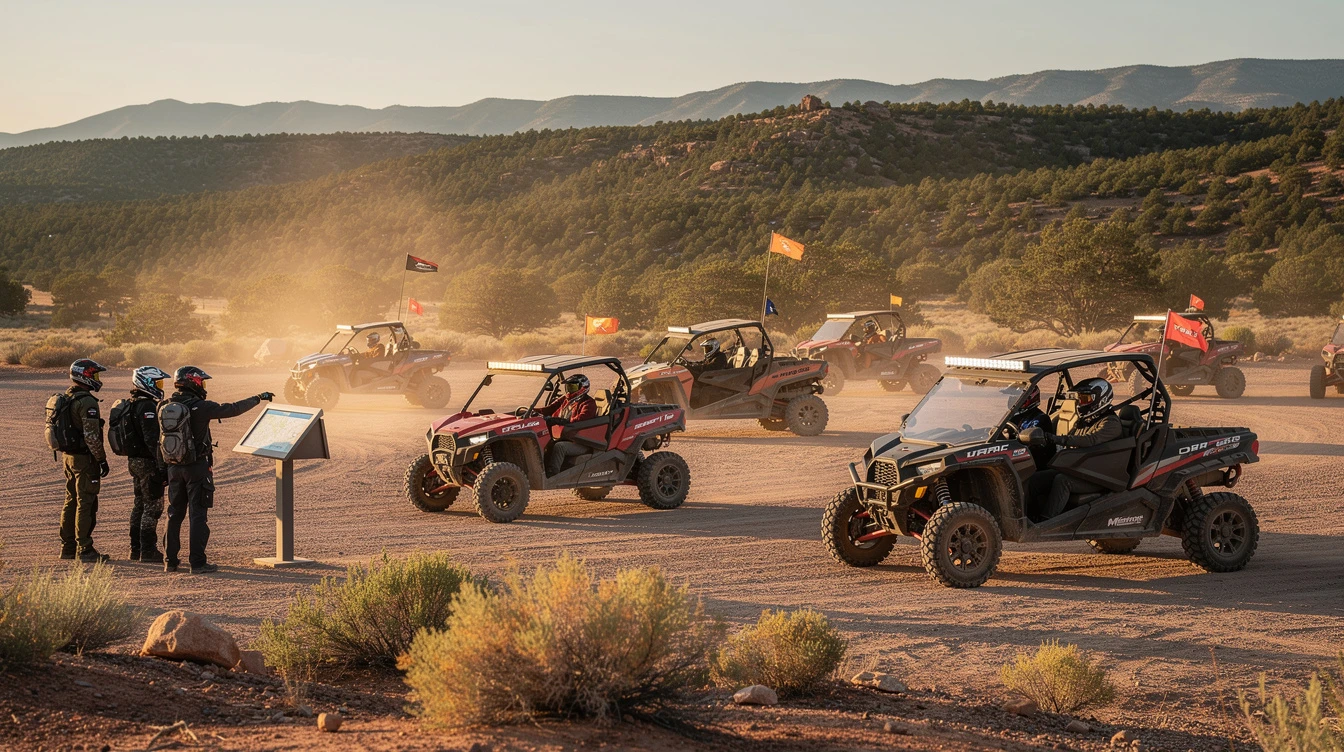
UTV safety requirements are not federal — they are set state by state, and they vary more than most riders expect. One state requires helmets for all ages. The next state over only requires them for riders under 18. Some states mandate DOT-approved seat belts. Others let you ride with just a lap bar. If you ride across state lines or plan to register in a different state than where you ride, understanding these differences is not optional.
This guide breaks down the major safety categories that states regulate, which states fall into which camp, and what you need to know before loading up the trailer.
The Five Categories Every State Regulates
While the specific rules differ, virtually every state with UTV regulations addresses the same five areas:
- Helmet requirements — who has to wear one and what standard it must meet
- Roll cage / ROPS requirements — whether the factory cage is sufficient
- Seat belt and restraint rules — mandatory or optional
- Required safety equipment — lights, mirrors, horn, flags
- Age restrictions — minimum age for operators and passengers
Helmet Laws: The Biggest Variable
Helmet laws for UTVs fall into three general tiers. Knowing which tier your state falls into determines what you pack before every ride.
| Tier | Rule | Example States |
|---|---|---|
| All riders | Helmets required for every occupant regardless of age | California, West Virginia, Oregon, New York |
| Under 18 only | Minors must wear helmets; adults may choose | Texas, Arizona, Utah, Idaho, Montana, Florida |
| No requirement | No helmet mandate for UTV occupants (ROPS/cage is considered sufficient) | South Dakota, Wyoming, some county-level jurisdictions |
Even in states without a helmet mandate, the Consumer Product Safety Commission (CPSC) and every major manufacturer strongly recommend DOT or Snell-certified helmets for all UTV occupants. The roll cage protects you in a rollover — it does not protect your head from branches, rocks, or ejection if you are not belted in.
What Counts as an Approved Helmet?
States that require helmets almost universally specify DOT FMVSS 218 certification. Some also accept Snell or ECE 22.06 ratings. Novelty helmets — the thin-shell decorative ones sold at gas stations — do not meet any of these standards and will get you cited in enforcement states.
Roll Cage and ROPS Standards
Every UTV sold in the United States since the early 2000s comes with a factory ROPS (Roll Over Protective Structure). This is not optional from the manufacturer — it is built into the vehicle. The question is whether your state requires the ROPS to remain intact and unmodified.
Most states require:
- Factory ROPS must remain installed and unmodified
- No cutting, bending, or removing cage members
- Aftermarket cages must meet or exceed OEM specifications
Some states go further and require ROPS certification documentation for registration. If you have replaced your factory cage with an aftermarket unit, keep the certification paperwork from the cage manufacturer. States like California and New York can request it during inspection.
Riders who modify their cages for accessories (light bars, roof racks, speaker mounts) should ensure the modifications do not compromise structural integrity. Drilling through cage tubes, for example, creates stress risers that can cause failure in a rollover — exactly when you need the cage most.
Seat Belt and Restraint Requirements
This is where Reddit threads get heated. On r/SideBySide, you will find passionate arguments about whether seat belts in a UTV help or hurt in a rollover. The data is clear: NHTSA research shows that occupant ejection is the leading cause of UTV fatalities, and seat belts prevent ejection.
State-by-State Belt Rules
Most states fall into one of two camps:
- Mandatory for all occupants: California, Oregon, New York, New Jersey, and most northeastern states require every occupant to wear the manufacturer-installed restraint system. This typically means the factory 3-point belt or, on sport models, the 4-point harness.
- Required if equipped: Many western and southern states use "required if equipped" language — if the manufacturer installed seat belts (which they all do now), you must wear them. This effectively makes belts mandatory on any modern UTV but technically exempts pre-2000 models that may not have had them.
No state explicitly says "seat belts are optional in a UTV with a roll cage." If your UTV has belts — and it does — you are expected to use them everywhere. The variation is in enforcement, not in the underlying requirement.
Required Safety Equipment for Street Use
If you want to drive your UTV on public roads, every state requires additional safety equipment beyond what comes stock. The exact list varies, but here is the common baseline:
| Equipment | Required Almost Everywhere | Required in Some States |
|---|---|---|
| Headlights (high/low beam) | Yes | — |
| Taillights / Brake lights | Yes | — |
| Turn signals | Yes | — |
| Horn (audible at 200 ft) | Yes | — |
| Rearview mirror(s) | Yes | Some require side mirrors too |
| Windshield | No | CA, NY, NJ, and others |
| Slow-moving vehicle emblem | No | States with speed-restricted UTVs |
| Whip flag (safety flag) | No | Sand dune areas (CA, OR, UT) |
A complete street legal guide covers the full equipment list and installation requirements. Most of this equipment can be added through aftermarket street legal kits that bolt on without permanent modification to the vehicle.
Age Restrictions and Supervision Rules
Age requirements are the area where states diverge most dramatically:
- No minimum age (with supervision): Several rural states including Montana, South Dakota, and Wyoming allow minors to operate UTVs on private land with no minimum age, though public land and road use has higher minimums.
- 12–15 year minimum for off-road: Most states set the off-road operating age between 12 and 15, often with a required safety course completion.
- 16+ for street legal operation: Every state that allows street legal UTVs requires the operator to hold a valid driver's license, which means 16 at minimum.
- Passenger age minimums: Some states set minimum ages for passengers that differ from operator minimums. California, for example, requires passengers to be tall enough to sit with their back against the seat and feet flat on the floor.
The Recreational Off-Highway Vehicle Association (ROHVA) publishes age recommendations that many states reference in their legislation: no passengers under age 12 in a UTV, and no operators under 16.
Trail vs. Road: Different Rules Apply
An important distinction that trips up many owners: trail safety rules and street legal safety rules are different categories. Your state forest or BLM land may have its own requirements — like whip flags, spark arrestors, or sound limits — that are completely separate from DMV street legal requirements.
For example, in Utah you might need a whip flag on sand dunes (trail rule) AND turn signals for road crossings (street legal rule). Missing either one can result in a citation, but they come from different regulatory authorities.
Understanding UTV laws in your specific state means checking both the motor vehicle code (for road use) and the parks/wildlife/land management rules (for trail use). They do not always agree, and the more restrictive rule wins.
How to Stay Compliant Across State Lines
If you trailer your UTV to ride in different states — and most enthusiasts do — the safest approach is to equip for the most restrictive state you plan to visit:
- Pack DOT helmets for every occupant regardless of your home state rules
- Keep factory seat belts and ROPS completely intact
- Install a full street legal kit (lights, horn, mirrors, signals) even if you only plan trail riding — you never know when you will need a road crossing
- Carry your registration, insurance card, and any required safety course certificates
- Check age restrictions before letting younger family members operate
Frequently Asked Questions
Do all states require helmets for UTV riders?
No. Helmet requirements vary significantly. States like California and New York require helmets for all occupants. States like Texas and Arizona only require them for riders under 18. A few states like South Dakota have no UTV helmet requirement at all. When in doubt, wear one — head injuries are the leading cause of UTV fatalities.
Can I remove my UTV roll cage for more clearance?
Removing or modifying the factory ROPS is illegal in most states and voids your manufacturer warranty. Even in states without explicit ROPS laws, operating a modified cage exposes you to significant liability in an accident. The cage is designed as a system — removing one bar can compromise the entire structure.
What safety equipment do I need for a street legal UTV?
At minimum: headlights, taillights, brake lights, turn signals, a horn audible at 200 feet, at least one rearview mirror, and seat belts. Some states also require a windshield, side mirrors, and a slow-moving vehicle emblem. Check your state-specific requirements for the complete list.
How old do you have to be to drive a UTV?
For off-road use on private land, some states have no minimum age. For public trails and off-road parks, most states require operators to be 12–16 with a safety course. For street legal operation on public roads, you need a valid driver's license — typically age 16 minimum in every state.
Are UTV safety courses required?
Several states require completion of an approved safety course for operators under 18. Some states (like California) require it for all ages when operating on state land. Even where not required, courses from ROHVA or your state's parks department are strongly recommended — and some insurance companies offer discounts for completion.