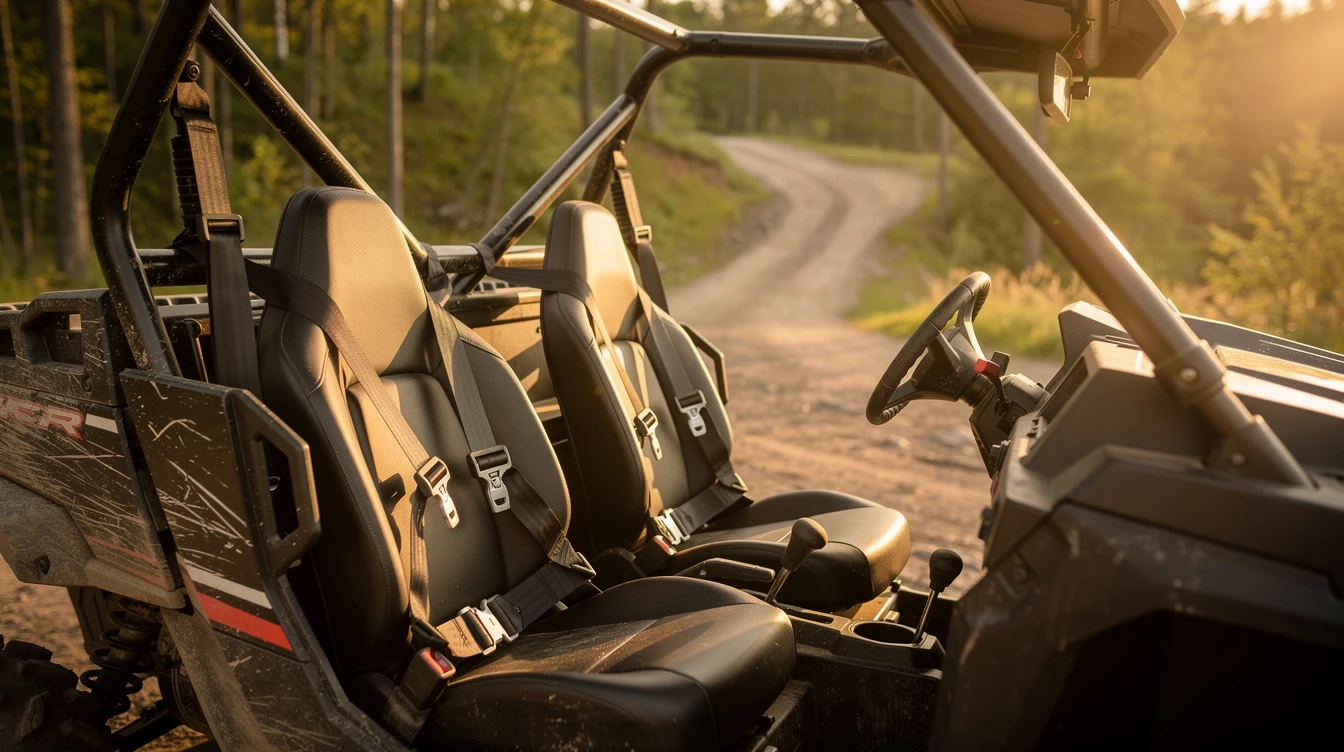
Every modern UTV comes with seat belts. Almost none come with airbags. That combination surprises people who assume side-by-sides should have the same safety features as cars and trucks. But UTVs operate in a fundamentally different environment — and the safety engineering reflects that difference.
Here is exactly what restraint systems UTVs use, why airbags are mostly absent, and what actually keeps you alive when things go wrong on the trail.
UTV Seat Belts: What Comes Standard
Every UTV manufactured since the mid-2000s includes factory seat belts for every seating position. The type of belt depends on the model category:
| UTV Category | Typical Belt Type | Example Models |
|---|---|---|
| Utility / Work | 3-point automotive-style | Kawasaki Mule, John Deere Gator, Polaris Ranger |
| Recreation / Crossover | 3-point with pretensioners | Polaris General, Can-Am Defender, Honda Pioneer |
| Sport / Performance | 4-point or 5-point harness | Polaris RZR Pro R, Can-Am Maverick X3, YXZ1000R |
3-Point vs. 4-Point vs. 5-Point Harnesses
The standard 3-point belt — the same lap-and-shoulder design in your car — works well for utility UTVs that operate at lower speeds on relatively smooth terrain. It allows freedom of movement for getting in and out, reaching tools, and operating implements.
Sport UTVs increasingly ship with 4-point harnesses (two shoulder straps, one lap belt) or 5-point harnesses (adds a crotch strap that prevents submarining under the lap belt). These keep your torso locked against the bolstered seat during aggressive cornering, jumps, and high-speed impacts. The Polaris RZR Pro R and Can-Am Maverick X3 RS both come factory-equipped with click-6 style harnesses.
The tradeoff is convenience. A 5-point harness takes 10–15 seconds to buckle properly every time you get in. For trail riding where you are stopping frequently to open gates or check trail markers, that gets old. For race-pace desert riding, it is non-negotiable.
Why UTVs Do Not Have Airbags
This is the question that gets asked constantly on r/SideBySide, and the answer comes down to physics and environment.
Open Cockpit Design
Most UTVs have open sides — no doors, or at best half-doors and nets. Airbags are designed to work inside a sealed passenger compartment where the bag deploys against the occupant and the surrounding structure contains the inflation. In an open-cockpit UTV, a steering wheel airbag would partially deploy into open air, reducing its effectiveness dramatically. Side airbags would deploy outward through open door openings.
Impact Direction Unpredictability
Cars crash primarily in forward, rear, and side impacts on flat surfaces. UTVs crash in every direction simultaneously — rollovers, drops off ledges, tree strikes at odd angles, and lateral slides into rocks. Airbag sensors are calibrated for specific impact directions and G-force thresholds. The constant high-G vibration and multi-axis impacts of off-road riding would cause false deployments or missed deployments at unacceptable rates.
Deployment Speed vs. Occupant Position
Automotive airbags deploy in 20–30 milliseconds. They are designed for an occupant sitting upright, facing forward, at a specific distance from the steering wheel. UTV occupants lean, bounce, brace against the cage, and shift position constantly. An airbag deploying into the face of an occupant who is leaned forward over the steering wheel causes more injury than it prevents.
The One Exception: Polaris
Polaris has experimented with cab-enclosed UTVs that include airbag systems, particularly in their RANGER XP Kinetic and certain crew cab models with full door systems. These are the closest thing to automotive-style enclosed cabins in the UTV world, and they are the only application where airbag deployment physics actually work correctly. As of 2026, these remain niche offerings rather than industry standard.
What Actually Keeps You Safe in a UTV
Since airbags are largely absent, UTVs rely on a three-part safety system that works together:
1. ROPS (Roll Over Protective Structure)
The roll cage is the primary safety structure. It creates a survival space around the occupants during a rollover — which is the most common serious UTV accident. Factory ROPS are engineered to withstand the weight of the vehicle landing on the cage from a specific drop height without collapsing into the occupant space.
Understanding state safety requirements for ROPS is essential since regulations about cage modifications vary significantly.
2. Restraint System (Seat Belts)
The seat belt keeps you inside the ROPS protection zone. According to NHTSA data, occupant ejection is the leading cause of UTV fatalities. The cage can be perfect, but if you are thrown from the vehicle, the cage cannot protect you — and the vehicle may land on you.
This is why seat belt use is the single most important safety decision a UTV rider makes. More important than helmet choice, more important than speed limits, more important than any accessory.
3. Nets and Doors
Factory-installed side nets and half-doors serve a specific purpose: preventing limbs from extending outside the cage during a rollover. Instinctive arm extension — reaching out to "catch yourself" during a tip — is a major cause of arm and hand injuries. The nets block this reflex and keep extremities inside the survival space.
Upgrading Your UTV Restraint System
If your UTV came with 3-point belts and you want better protection, aftermarket harnesses are one of the most worthwhile upgrades you can make:
- 4-point harness kits: $150–$400 per seat. Bolt to factory mounting points on most models. Significant upgrade for any sport or crossover UTV.
- 5-point harness kits: $200–$500 per seat. Best protection available. Required for most organized racing events. Adds a crotch/anti-submarine strap.
- Harness bar: $100–$300. Provides a proper mounting point behind the seats for shoulder straps. Prevents the straps from pulling at an improper angle.
- Seat upgrades: $300–$800 per seat. Deeper bolstering keeps you centered in the seat during lateral loads. Works with harnesses for maximum retention.
When upgrading, use SFI 16.1 or FIA-rated harnesses from reputable brands (Crow, Simpson, PRP, Dragonfire). Avoid unrated straps from unknown sellers — the webbing material, stitching pattern, and hardware quality all affect whether the harness holds or fails under load.
How Restraints Compare: UTV vs. ATV vs. Car
For context on where UTVs sit in the safety spectrum compared to other vehicles:
| Feature | Car | UTV | ATV |
|---|---|---|---|
| Seat belts | 3-point standard | 3-point to 5-point | None |
| Airbags | 6–10 standard | Rare / none | None |
| Roll protection | Roof crush resistance | ROPS cage | None |
| Side impact protection | Door beams + curtain airbags | Nets / half-doors | None |
| Ejection prevention | Belt + locked doors | Belt + nets | Active rider balance |
This comparison makes clear why UTVs are significantly safer than ATVs — the cage and belt system provides genuine occupant protection that ATVs completely lack. At the same time, UTVs are not cars, and expecting automotive-level passive safety from a 1,500-pound off-road machine is unrealistic.
Frequently Asked Questions
Do any UTVs come with airbags from the factory?
Very few. Polaris has offered airbag-equipped cab systems on select enclosed RANGER models, but these are niche offerings. The vast majority of UTVs — including all sport and most recreation models — do not include airbags and are not designed to accommodate them.
Are UTV seat belts the same as car seat belts?
Basic 3-point UTV belts use similar technology to automotive belts, but sport UTV harnesses (4-point and 5-point) are closer to racing harnesses. They use wider webbing, metal cam-lock or latch-and-link buckles, and mount at different angles than automotive belts to keep occupants locked into bolstered seats.
Can I add airbags to my UTV aftermarket?
No reputable manufacturer offers aftermarket airbag kits for UTVs, and for good reason. Airbag systems require precise crash sensors, specific deployment distances, and controlled passenger compartment geometry that open-cockpit UTVs do not provide. Installing an improper airbag system creates more danger than it prevents.
What is the most important safety upgrade for a UTV?
A proper harness system. Upgrading from a 3-point belt to a 4-point or 5-point harness with a harness bar is the single most effective safety improvement you can make. It prevents ejection and keeps you centered in the seat during impacts — the two factors that matter most in real-world UTV accidents.
Do you have to wear a seat belt in a UTV?
Yes, in every practical sense. While enforcement varies by state, every modern UTV comes equipped with seat belts, and every state with UTV regulations either mandates their use or requires them "if equipped" — which means every modern UTV. More importantly, NHTSA data consistently shows that unbuckled occupants account for the overwhelming majority of UTV fatalities.