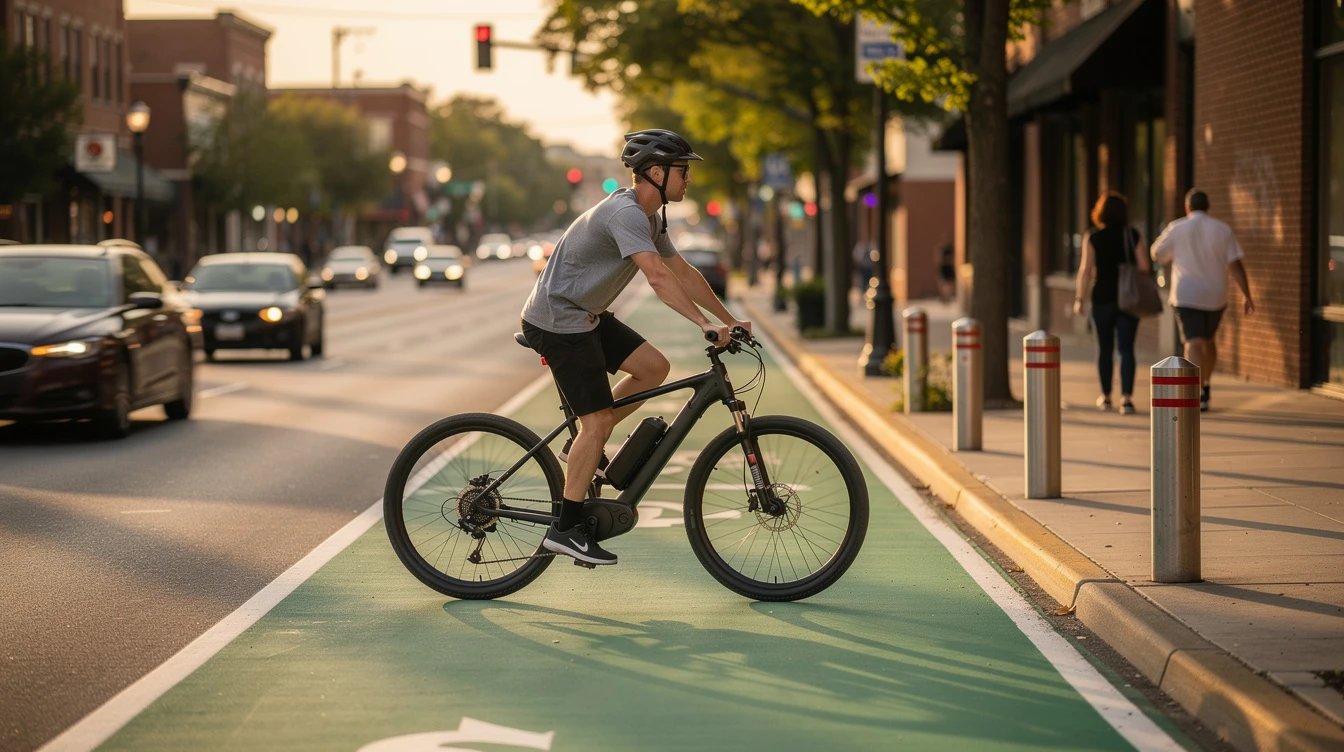
E-bike speed limits in the United States are defined by class: 20 mph for Class 1 and Class 2, 28 mph for Class 3. These are not suggestions — they are the legal thresholds that determine whether your electric bike is treated as a bicycle or as a motor vehicle. Exceed them and you cross from bike lanes and trails into moped and motorcycle territory, with all the licensing and registration that comes with it.
Here is exactly how e-bike speed limits work, how they are enforced, and what happens when your bike goes faster than the law allows.
Speed Limits by E-Bike Class
| Class | Max Motor-Assisted Speed | Motor Activation | Can You Go Faster Under Pedal Power? |
|---|---|---|---|
| Class 1 | 20 mph | Pedal-assist only (motor engages when you pedal) | Yes — motor cuts out but you can pedal faster |
| Class 2 | 20 mph | Throttle and/or pedal-assist | Yes — throttle cuts out at 20 but pedaling continues |
| Class 3 | 28 mph | Pedal-assist only (no throttle in most states) | Yes — motor cuts out at 28 |
An important distinction: the speed limit applies to motor-assisted speed, not your total speed. If you are on a Class 1 e-bike going downhill and your speedometer reads 35 mph, that is legal — the motor is not providing assistance above 20 mph. Your legs and gravity are doing the work. The e-bike classification only governs at what speed the motor stops helping.
How Speed Limits Are Actually Enforced
E-bike speed enforcement is one of the most debated topics on r/ebikes, and the honest answer is: inconsistently.
On Roads
When riding on public roads, e-bikes are subject to the same traffic speed limits as any other vehicle. If the posted speed limit is 25 mph and your Class 3 e-bike is doing 28 mph, you can technically receive a speeding ticket — just like a cyclist on a regular bike exceeding the speed limit (which happens on downhills regularly). In practice, police rarely ticket e-bikes on roads for speed unless the behavior is dangerous.
On Bike Paths and Multi-Use Trails
This is where enforcement matters more. Many bike paths have posted speed limits of 15 mph regardless of vehicle type. On these paths:
- Class 1: Allowed on most paths, but you should respect the posted path speed limit (often 15 mph)
- Class 2: Allowed in most states, but some jurisdictions ban throttle-equipped bikes from multi-use paths
- Class 3: Banned from most multi-use paths and bike paths in states that have adopted the three-class system. Restricted to roads and protected bike lanes.
Park rangers and trail managers are generally more attentive to e-bike speeds on shared paths than police are on roads. Getting cited for exceeding path speed limits — or for riding a Class 3 on a Class 1-only path — is a real possibility in actively managed trail systems.
The Unlocked Speed Question
Many e-bikes can be "unlocked" through firmware settings, aftermarket controllers, or display modifications to exceed their rated class speed limit. For example, a Class 2 e-bike limited to 20 mph motor assist might be unlockable to 25 or 30 mph.
Once unlocked, the e-bike no longer conforms to its rated class. Legally, it becomes a non-conforming electric vehicle — potentially classified as a moped or motorcycle depending on the state and the actual speed capability. The original class label on the frame is irrelevant if the bike's actual performance exceeds the class specification.
State-by-State Speed Limit Variations
While most states follow the 20/28 mph class framework, there are notable exceptions:
States with Standard Three-Class Speeds
California, Colorado, Texas, Florida, Arizona, Georgia, Illinois, Indiana, Michigan, Oregon, Tennessee, Utah, Virginia, Washington, and approximately 20 other states use the standard 20 mph (Class 1/2) and 28 mph (Class 3) thresholds. Check our e-bike laws by state guide for your state's specific adoption status.
States with Different Thresholds
- New York: Uses 20 mph for Class 1, 20 mph for Class 2, and 25 mph (not 28) for Class 3.
- Connecticut: Defines electric bicycles with a 20 mph threshold only — no Class 3 equivalent.
- Massachusetts: Uses a 25 mph threshold for the boundary between electric bicycle and motorized bicycle.
- New Jersey: Adopted the three-class system in 2020 with standard speeds, but local municipalities can further restrict e-bike access and speeds on specific paths.
Federal Land (National Parks, BLM, National Forests)
Federal land follows its own rules. The National Park Service allows Class 1, 2, and 3 e-bikes on roads and trails where traditional bicycles are permitted, subject to each park's specific management policies. BLM land generally follows similar guidelines but individual field offices can restrict e-bike access. National Forest trails managed by the USFS may or may not allow e-bikes depending on the trail designation.
What Happens If Your E-Bike Exceeds the Speed Limit?
The consequences of exceeding e-bike speed limits depend on where you are riding and how much you are exceeding them:
| Scenario | Likely Consequence |
|---|---|
| Class 1/2 going 22 mph under pedal power (motor cut off) | Legal — motor is not assisting above 20 mph |
| Class 3 going 28 mph on a road with 30 mph speed limit | Legal — within road speed limit and class limit |
| Class 3 going 28 mph on a bike path with 15 mph limit | Speeding citation + possible ban from path |
| Unlocked e-bike with motor assist above 28 mph | Reclassified as moped/motorcycle — operating without registration/license |
| High-powered e-bike (Sur-Ron, etc.) doing 45+ mph | Operating an unregistered motorcycle — citation, possible impoundment |
Speed Limiters and How They Work
Every compliant e-bike has a speed limiter built into the motor controller. This limiter cuts motor power at the rated class speed — the motor simply stops assisting when the bike reaches 20 or 28 mph. The bike does not brake or slow down; it just stops adding power.
Speed limiters work through:
- Wheel speed sensor: A magnet on the wheel and a sensor on the fork measure actual speed. When the threshold is reached, the controller reduces power to zero.
- Controller firmware: The maximum assisted speed is programmed into the motor controller's firmware. Changing this setting (through the display menu or a third-party app) is the most common way riders "unlock" their bikes.
- Pedal cadence sensor: On pedal-assist-only bikes, the motor engages based on pedaling speed and cadence. At higher speeds, the assist level decreases proportionally.
Choosing the Right E-Bike Class for Your Riding
Speed needs should drive your class selection:
- Commuting on bike paths and multi-use trails: Class 1. Maximum trail access, no speed-related restrictions on any path that allows bicycles.
- Urban commuting on roads: Class 3. The extra 8 mph of assisted speed (28 vs 20) makes a meaningful difference in keeping up with traffic flow on 25–30 mph urban roads.
- Casual riding and errands: Class 2. The throttle is convenient for starting from stops and short low-speed segments without pedaling.
- High-speed or off-road: If you need more than 28 mph of motor-assisted speed, you are shopping for a moped or motorcycle — not an e-bike. Understand the licensing requirements that come with that classification.
Speed and Safety
Higher speed means higher risk. NHTSA data on bicycle and e-bike accidents shows that injury severity increases significantly above 20 mph. At 28 mph, a crash has roughly 2.5x the kinetic energy of a 20 mph crash. The human body is not designed to absorb that impact without protection.
Class 3 riders should seriously consider:
- A MIPS-equipped helmet (provides rotational impact protection beyond basic DOT certification)
- High-visibility clothing or vest for road riding
- Front and rear lights, even during daylight
- Gloves (hands hit the pavement first in most bicycle crashes)
Frequently Asked Questions
What is the maximum legal speed for an e-bike in the US?
28 mph motor-assisted speed for a Class 3 e-bike. Class 1 and Class 2 are limited to 20 mph motor-assisted speed. You can exceed these speeds under your own pedal power (going downhill, for example), but the motor must cut out at the class threshold.
Can I unlock my e-bike to go faster?
Technically you can modify the firmware to remove the speed limiter, but doing so reclassifies your e-bike. It is no longer a Class 1, 2, or 3 e-bike — it becomes a non-conforming electric vehicle subject to moped or motorcycle regulations. This means you lose access to bike lanes, bike paths, and the no-license/no-registration benefits of e-bike classification.
Are e-bike speed limits different on roads vs. bike paths?
The e-bike class speed limit (20 or 28 mph motor cutoff) applies everywhere. But bike paths and trails often have posted speed limits (commonly 15 mph) that apply to all users — cyclists, e-bikes, joggers. You must follow both: the class limit and the posted path limit, whichever is lower.
Can I get a speeding ticket on an e-bike?
Yes. E-bikes are subject to traffic laws including speed limits. If you exceed the posted speed limit on a road or path, you can receive a citation just like any other vehicle operator. On roads this is rare for e-bikes at legal speeds; on paths it is more common where rangers actively enforce limits.
Why are Class 3 e-bikes banned from some bike paths?
Safety. Shared-use paths accommodate pedestrians, dog walkers, children, and slower cyclists. A 28 mph e-bike on a path designed for 10–15 mph mixed traffic creates collision risks that most trail managers consider unacceptable. Class 3 bikes are designed for road use, where e-bike road regulations apply.