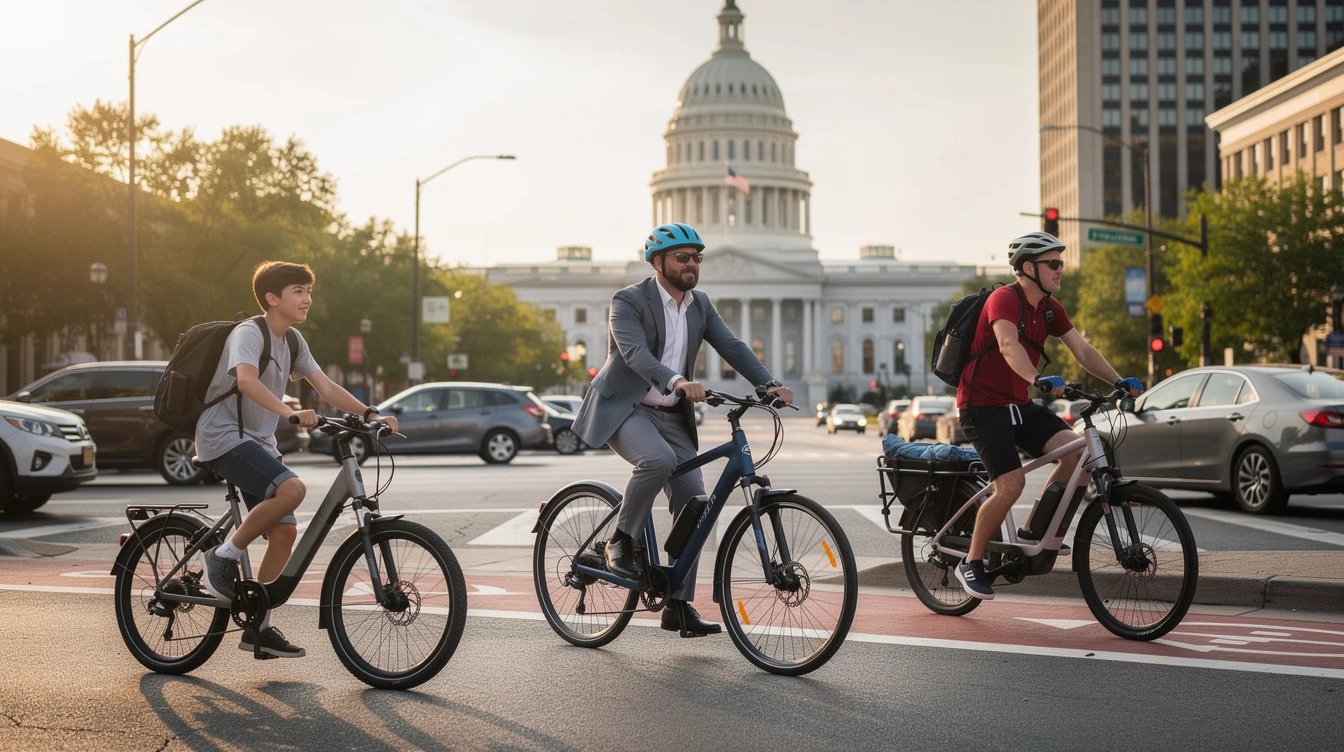
What Are E-Bikes, and Why Do They Matter?
An electric bicycle (e-bike) is a bicycle equipped with an integrated or auxiliary electric motor that provides propulsion assistance to the rider. The U.S. federal government defines a low-speed electric bicycle as a bicycle with a motor of 750 watts or less, capable of a maximum speed of 20 mph when the motor acts alone (without pedaling). This definition, established by the Consumer Product Safety Commission in 2002, forms the legal foundation for how e-bikes are classified, regulated, and permitted across the United States.
E-bicycles are not a recent invention. The first patent for an electric bicycle was issued in 1895, and motorized bicycles became common in European cities by the 1920s. However, the modern e-bike market emerged after the lithium-ion battery revolution of the early 2000s, which made electric motors lighter, more affordable, and practical for daily commuting. U.S. e-bike sales have grown 20-30% annually since 2015, with market data showing over 1.1 million e-bikes sold in the United States in 2022 alone. This rapid growth has forced state legislatures and local municipalities to develop consistent classification systems and safety regulations to address questions about where e-bikes can operate, what safety equipment is required, and whether riders need licensing or registration.
The Federal Definition: How the 750-Watt, 20-MPH Standard Came About
In 2002, the Consumer Product Safety Commission (CPSC) established the foundational federal guidelines for electric bicycles. These guidelines defined a low-speed electric bicycle as a bicycle with a motor of no more than 750 watts, capable of a maximum speed of 20 mph when the motor operates alone, without any pedal assist from the rider. This definition was not arbitrary.
The CPSC based the 750-watt and 20-mph thresholds on two factors: (1) international precedent, particularly the European Union's adoption of identical limits in 1999, and (2) practical engineering testing that showed bicycles operating within these parameters retain the handling characteristics and safety profile of pedal-powered bicycles. At 750 watts and 20 mph, an e-bike does not trigger the structural safety requirements, braking standards, or crash-protection equipment mandated for mopeds, motorcycles, or other motor vehicles.
However, the federal definition did not create a binding classification system. Instead, it established a legal ceiling,anything below 750W and 20 mph could be classified as a bicycle for regulatory purposes. States were free to adopt, modify, or exceed these federal guidelines. In 2015, California became the first state to codify a three-class system into statute, creating a graduated framework that distinguished between different types of motor assistance and cutoff speeds. Other states followed California's model, while some retained the federal 750W/20mph standard, and a few created their own systems entirely. This fragmentation is the primary reason riders and regulators face conflicting rules across state and local boundaries.
Understanding the Three-Class E-Bike System
The three-class e-bike system, first enacted into law by California in 2015 and subsequently adopted by 38 U.S. states as of 2024, categorizes electric bicycles based on two technical variables: (1) the type of motor engagement (pedal-assist versus throttle), and (2) the speed at which the motor automatically cuts off (either 20 mph or 28 mph). These distinctions were created because different motor behaviors create measurably different riding dynamics, user skill requirements, and safety profiles in shared-use spaces.
Definition: Pedal-Assist (also called Pedal Electric Cycle or PEC) , A motor engagement system in which the electric motor provides power only when the rider is actively pedaling. The motor automatically disengages when the rider stops pedaling or when the bicycle reaches a preset speed limit.
Definition: Throttle-Assist , A motor engagement system in which the rider can command full electric motor power without pedaling, via a handlebar-mounted throttle control (similar to a motorcycle throttle). The motor operates independently of pedal input.
Definition: Motor Cutoff Speed , The maximum speed at which an electric motor continues to provide assistance before automatically disengaging. This is not the top speed the bicycle can achieve, but rather the speed at which the motor stops assisting the rider.
Class 1: Pedal-Assist, 20 mph Cutoff , A Class 1 electric bicycle uses a pedal-assist motor that engages only when the rider is actively pedaling. The motor automatically disengages when the rider stops pedaling or when the bicycle reaches 20 mph. Because the motor engagement is directly tied to the rider's pedal input, Class 1 e-bikes maintain the fundamental riding dynamic of a standard bicycle: the rider controls power delivery through leg effort. From an observer's perspective, a Class 1 e-bike is visually and behaviorally nearly identical to a standard bicycle. This resemblance is why Class 1 e-bikes face the fewest regulatory restrictions. In all 38 states that have adopted the three-class system, Class 1 e-bikes are permitted on public roads, and they are permitted on municipal and state bike paths in 37 of 38 states (Colorado is the sole exception, where some local jurisdictions restrict Class 1 e-bikes from certain multi-use paths). No license, registration, or insurance is required anywhere in the United States for Class 1 e-bike riders.
Class 2: Throttle-Assist, 20 mph Cutoff , A Class 2 electric bicycle is equipped with a throttle control that allows the rider to command electric motor power without pedaling. The motor automatically disengages at 20 mph. Class 2 e-bikes introduce a significant behavioral change: the rider can drive the bicycle forward without any physical exertion, simply by twisting the throttle. This capability matters deeply to trail managers, park administrators, and local authorities because it changes user behavior in shared-use spaces. A rider can climb a hill or accelerate without effort, which some jurisdictions view as introducing motor-vehicle operating patterns into spaces designed for human-powered transport. As of 2024, Class 2 e-bikes are permitted on public roads in all 38 three-class states, but bike-path and multi-use trail permissions vary significantly by municipality. Approximately 22 states allow Class 2 e-bikes on some or all bike paths, while 16 states restrict Class 2 from most or all multi-use trails, leaving path access to local municipal ordinance. No license or registration is required for Class 2 riders.
Class 3: Pedal-Assist, 28 mph Cutoff , A Class 3 electric bicycle uses a pedal-assist motor (like Class 1), meaning the motor engages only when the rider is pedaling. The critical difference is that the motor continues to provide assistance until the bicycle reaches 28 mph, rather than disengaging at 20 mph. That additional 8 mph threshold is legally significant: 20 mph is the speed of a fit amateur cyclist, while 28 mph approaches the speed of light traffic on residential streets. Class 3 e-bikes are therefore perceived by regulators as higher-speed vehicles that create greater interaction risks in mixed-use environments. Many states require Class 3 e-bikes to be equipped with a functioning speedometer so riders can monitor when they approach the 28 mph cutoff. Class 3 e-bikes are permitted on public roads in all states that have adopted the three-class system, but they are prohibited from bike paths and multi-use trails in 31 of 38 states. Only 7 states permit Class 3 e-bikes on some or all publicly maintained bike paths. Some states impose helmet requirements specifically for Class 3 riders (or riders under age 16 on Class 3 bikes), even though no state requires helmets for standard bicycle riders. No license or registration is required for Class 3 riders, but some states require a manufacturer label affixed to the frame indicating the e-bike's class.
State-by-State Variation: Why E-Bike Rules Differ Across Jurisdictions
As of 2024, 38 U.S. states have adopted the three-class e-bike system into statute. However, the remaining 12 states use the federal 750W/20mph definition only, treat e-bikes under general bicycle laws without specific classification, or have no dedicated e-bike statute at all. Additionally, even within states that have adopted the three-class system, individual cities and counties maintain authority to impose stricter rules on e-bike use within their jurisdictions.
This fragmentation exists because e-bike regulation sits at the intersection of three separate legal authorities:
- Federal law sets the baseline definition (750W/20mph for low-speed electric bicycles) and establishes CPSC safety standards for motor and battery components.
- State law determines whether to adopt the three-class system, modify the federal thresholds, or allow local control.
- Local municipal law sets specific rules about where e-bikes can operate (public roads, bike paths, trails, parks) and whether additional equipment (lights, bells, helmets) is required.
This layered structure creates real legal conflicts. A rider who owns a Class 3 e-bike that is street-legal in California (which recognizes Class 3) could immediately violate Nevada law by riding the same bicycle across the state border, because Nevada uses only the federal 750W/20mph definition and does not recognize Class 3. Similarly, a Class 2 e-bike that is permitted on bike paths in Colorado might be banned from the same trail system if it crosses into Wyoming, where local park rules prohibit motor-assisted bicycles from multi-use trails.
The Liability and Safety Basis for Bike-Path Restrictions
E-bike restrictions on bike paths and multi-use trails are not arbitrary. They stem from documented safety concerns and liability exposure.
In 2019, the Consumer Product Safety Commission (CPSC) received injury reports related to e-bike riders, revealing increased accident rates on shared-use paths where e-bikes and standard cyclists mixed. Data from a 2023 study published in the journal Injury Epidemiology showed that e-bike riders had emergency department visit rates approximately 1.5 times higher than standard bicycle riders, with the majority of injuries occurring in urban environments and on shared-use trails rather than dedicated motor-vehicle roads.
From a liability perspective, municipalities that maintain bike paths face legal exposure if an e-bike rider injures another path user (a pedestrian, standard cyclist, or runner). A rider moving at 28 mph on a bike path designed for 12-15 mph traffic creates a collision risk that standard path design and signage were not engineered to accommodate. If a municipality permits e-bikes on paths and an injury occurs, the municipality could be held liable for negligence if it failed to update path design, signage, or enforcement policies to account for faster vehicles.
Some park administrators also cite maintenance costs: heavier e-bikes (which typically weigh 50-65 pounds, versus 25-30 pounds for standard bicycles) create greater wear and tear on bike-path surfaces, particularly in areas with poor drainage or sandy soil.
For these reasons, 31 of 38 three-class states explicitly restrict Class 3 e-bikes from bike paths, and 16 states restrict Class 2 e-bikes from some or all multi-use trails. Class 1 e-bikes, which closely resemble standard bicycles in behavior and speed, face restrictions in only 1 state (Colorado, in specific jurisdictions).
Licensing, Registration, and Motor Vehicle Classification
An electric bicycle that meets the federal definition (750W or less, 20 mph cutoff) is classified as a bicycle, not a motor vehicle, under federal law and in all 50 states. This means that Class 1 and Class 2 e-bikes, and Class 3 e-bikes in states that recognize the three-class system, do not require a driver's license, do not require vehicle registration, do not require a title, and do not require liability insurance.
However, an e-bike that exceeds the state's statutory definition of a bicycle crosses a legal threshold: it becomes reclassified as a motor vehicle, specifically as a moped, motorized bicycle, or motorcycle, depending on the state and the degree to which it exceeds the thresholds.
Definition: Motor Vehicle Reclassification , The legal process by which a bicycle or similar device that exceeds state power or speed limits is formally recategorized as a motor vehicle, triggering all associated licensing, registration, insurance, and safety equipment requirements.
The reclassification thresholds vary by state:
- California: Any e-bike exceeding 750W or 28 mph (the Class 3 maximum) is reclassified as a motorized bicycle or motorcycle.
- New York: Any e-bike exceeding 750W or 20 mph is reclassified as a motorcycle.
- Florida: E-bikes are limited to 750W and 20 mph; anything above those thresholds is classified as a motorcycle.
- Texas: Uses the federal 750W/20mph definition; anything exceeding those limits must be registered as a motorcycle.
When an e-bike or custom electric bicycle is reclassified as a motor vehicle, the owner must comply with the full regulatory framework for that vehicle class. This includes:
- Operator's License: The rider must have a valid driver's license or motorcycle endorsement on their license. Most states require a motorcycle endorsement exam if the bike exceeds a certain power threshold (typically 50cc equivalent or higher).
- Vehicle Registration: The vehicle must be registered with the state DMV, and the owner must pay annual registration fees (typically $50-$200, depending on the state).
- Certificate of Title: The state DMV issues a title document proving ownership, which is required for any sale or transfer of the vehicle.
- Liability Insurance: Most states require a minimum level of liability insurance for motorized vehicles (typically $25,000-$50,000 per-person coverage).
- Safety Equipment: The vehicle must be equipped with state-mandated safety equipment, including a headlight, taillight, horn, reflectors, a functioning speedometer, and brakes that meet performance standards.
- Helmet Requirement: Most states require riders of motorized bicycles and mopeds to wear a Department of Transportation (DOT)-approved motorcycle helmet.
For owners of high-power custom e-bikes or vehicles that don't fit neatly into standard moped or motorcycle categories, registration can be complicated. A Montana LLC is a legal structure that allows vehicle owners to register unique or non-standard vehicles through a registered business entity, which some states recognize for titling and registration purposes when standard DMV categories don't apply. Read more in Montana LLC for Vehicle Owners: Skip the Tax, Keep the Plates.
| E-Bike Class / Type |
← Back to Blog
Compliance Notice
Street Legal Hookup is a private third-party service and is not affiliated with any DMV, state agency, or government office. Services involve assistance and guidance with vehicle paperwork, Montana LLC filings, title support, and related registration processes.
Street Legal Hookup is a privately owned company providing private Montana LLC formation, registered agent, and corporate filing support for vehicle owners. We are not a government office, not the Department of Motor Vehicles, and not affiliated with the State of Montana or any other state government. We provide document-preparation and filing assistance only; customers remain responsible for their own filings. Street Legal Hookup is headquartered in Lutz, Florida. |
|---|