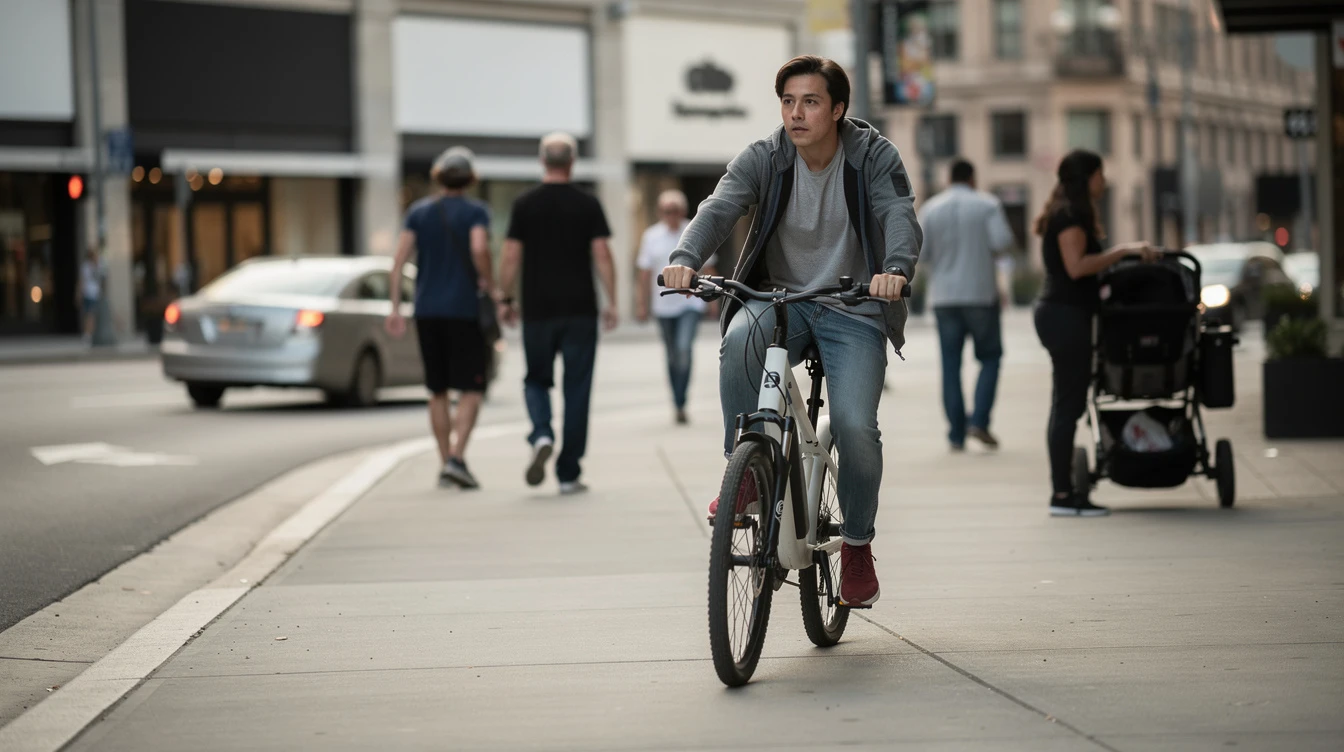
The short answer: it depends on where you are. Most states do not explicitly ban e-bikes from sidewalks at the state level — but most cities do, at least in commercial and downtown areas. The rules change based on your e-bike class, your city's municipal code, and sometimes even which block you are riding on.
This creates a confusing patchwork that frustrates riders and pedestrians alike. Here is how to navigate it.
The State vs. City Divide
E-bike sidewalk regulations operate on two levels that do not always agree:
- State law sets the baseline — whether e-bikes are classified as bicycles, and whether bicycles are allowed on sidewalks statewide
- Local ordinances override the state baseline. A city can ban sidewalk cycling even if the state allows it, and a city can allow it even where the state is silent
This means there is no single national answer. The rules on one side of a city limit sign may be completely different from the other side.
State-Level Sidewalk Rules
States generally fall into three categories regarding bicycles (and by extension, e-bikes classified as bicycles) on sidewalks:
| Category | Rule | Example States |
|---|---|---|
| Allowed unless locally prohibited | State law permits sidewalk cycling; cities may opt out | Arizona, Florida, Georgia, Ohio, Texas |
| Prohibited statewide | State law bans cycling on sidewalks | Few states ban cycling on all sidewalks statewide — this is rare |
| Deferred to local authority | State law does not address sidewalks; cities decide | California, Colorado, New York, Oregon, Washington |
In the "deferred to local" states — which include most large states — you need to check your specific city or county ordinance. There is no shortcut.
How E-Bike Class Affects Sidewalk Access
Even in places where regular bicycles are allowed on sidewalks, e-bikes may face additional restrictions based on class:
Class 1 (Pedal-Assist, 20 mph)
Class 1 e-bikes receive the most permissive treatment. In jurisdictions that allow bicycles on sidewalks, Class 1 e-bikes are almost always included because they require pedaling to activate the motor — functionally identical to a regular bicycle from a pedestrian interaction standpoint (though faster).
Class 2 (Throttle, 20 mph)
Class 2 e-bikes face more restrictions. The throttle capability — allowing the bike to move without pedaling — pushes some jurisdictions to treat them more like mopeds than bicycles. Cities that specifically restrict "motorized vehicles" from sidewalks may catch Class 2 e-bikes in that definition, even if they allow Class 1.
Class 3 (Pedal-Assist, 28 mph)
Class 3 e-bikes are the most restricted on sidewalks. Their higher speed capability (28 mph motor-assisted) makes them incompatible with pedestrian environments. Most jurisdictions that have adopted the three-class system explicitly restrict Class 3 e-bikes to roads and protected bike lanes — no sidewalks, no multi-use paths.
Understanding how e-bike speed limits work helps explain why Class 3 faces heavier restrictions — a 28 mph bike among pedestrians walking at 3 mph creates a dangerous speed differential.
Major City Rules
Here is what the largest US cities actually enforce:
New York City
Bicycles and e-bikes are prohibited on all NYC sidewalks. Violations carry fines of $100–$300. This is actively enforced, especially in Manhattan. E-bikes are restricted to roads, protected bike lanes, and greenways.
Los Angeles
California defers to local law. LA Municipal Code prohibits cycling on sidewalks in business districts but allows it in residential areas. Class 3 e-bikes are restricted to roads statewide.
Chicago
Bicycle riding on sidewalks is prohibited in Chicago's business district. Outside the district, it is allowed for riders over 12 years old. E-bikes classified as bicycles follow the same rules.
Houston
Texas allows sidewalk cycling unless locally prohibited. Houston allows bicycles on sidewalks but prohibits "reckless" operation. E-bikes under 750W follow bicycle rules.
Phoenix
Arizona allows sidewalk cycling statewide. Phoenix follows state law — bicycles and e-bikes (Class 1 and 2) are permitted on sidewalks as long as riders yield to pedestrians.
Portland
Bicycles are allowed on most Portland sidewalks except in the downtown core (the area bounded by the Willamette River and I-405). This applies to e-bikes classified as bicycles.
Denver
Sidewalk cycling is allowed in Denver except in designated "no riding" zones (typically the downtown core and areas near major venues). E-bikes follow the same restrictions as bicycles.
Why Sidewalk Riding Is Controversial
The debate on r/ebikes and local cycling forums is fierce because both sides have legitimate points:
The Case Against Sidewalk E-Biking
- Speed differential: Even a Class 1 e-bike at 15 mph is 5x faster than a walking pedestrian. Class 2 and 3 are worse. This speed gap creates collision risks at every driveway, doorway, and intersection.
- Pedestrian safety: Pedestrians are the most vulnerable road users. Adding 50+ pound e-bikes traveling at 15–28 mph to their space creates genuine danger, especially for elderly pedestrians, children, and people with visual impairments.
- Intersection conflicts: Drivers turning across sidewalks expect pedestrian-speed traffic. A cyclist or e-bike rider crossing the driveway at 15 mph enters the conflict zone much faster than drivers anticipate.
- ADA accessibility: Sidewalks are pedestrian infrastructure. Adding motor vehicles — even small ones — to spaces designed for pedestrians conflicts with ADA accessibility principles.
The Case For Allowing Sidewalk E-Biking
- Road safety: In many areas, the road is more dangerous for e-bike riders than the sidewalk is for pedestrians. Riders forced onto roads without bike lanes face traffic traveling at 35–50 mph.
- Infrastructure gaps: Most American cities lack connected bike lane networks. Forcing e-bikes off sidewalks and onto roads without safe infrastructure increases rider fatalities.
- Low-speed operation: Responsible sidewalk riders travel at 5–8 mph — barely faster than a jogger. The speed capability of the bike does not mean riders use full speed on sidewalks.
- Practical necessity: Sometimes a short sidewalk segment is the only safe connection between two bike lanes or paths. A blanket ban forces riders onto dangerous road segments for 50 feet of sidewalk.
Best Practices for Sidewalk Riding (Where Legal)
If you are in a jurisdiction that allows sidewalk e-biking, these practices keep you legal and safe:
- Slow down significantly. Match pedestrian pace — 5–8 mph maximum. The fact that your bike can go 20+ mph does not mean it should on a sidewalk.
- Yield to every pedestrian. Pedestrians always have the right of way on sidewalks. Pass only when you can give them space and they are aware of your presence.
- Use an audible signal. A bell or verbal "on your left" before passing gives pedestrians time to react. Do not assume they hear your motor — many e-bikes are nearly silent.
- Walk through crowded areas. If the sidewalk is congested, dismount and walk your bike. No one benefits from you weaving through a crowd at any speed.
- Use the road or bike lane when available. The sidewalk should be the option of last resort, not the default route. If bike infrastructure exists, use it.
- Watch every driveway and intersection. Drivers do not see you coming at sidewalk-crossing speeds. Make eye contact before crossing in front of turning vehicles.
What Happens If You Get Cited
Sidewalk cycling violations are typically municipal infractions (not criminal offenses) with fines ranging from $25 to $300 depending on the jurisdiction. In some cities, repeat violations can result in higher fines. Your e-bike will not be impounded for a sidewalk violation under normal circumstances.
However, if your e-bike exceeds the e-bike classification thresholds (over 750W or over 28 mph), sidewalk riding may result in operating-an-unregistered-motor-vehicle charges, which are more serious. Keeping your e-bike within its rated class and understanding licensing requirements prevents this escalation.
Alternatives to Sidewalk Riding
If your area bans sidewalk e-biking, these alternatives keep you safe and legal:
- Protected bike lanes: The safest option. Physically separated from both pedestrians and motor vehicles.
- Painted bike lanes: Less safe than protected lanes but better than sharing the general traffic lane.
- Shared lane markings (sharrows): Indicate that bicycles share the lane with traffic. Ride in the center of the lane, not the gutter.
- Low-speed residential streets: Streets with 25 mph speed limits and low traffic volume are often safer than sidewalks for e-bike riding.
- Multi-use paths: Where available, these are designed for mixed bicycle and pedestrian use with wider lanes and better sight lines than sidewalks. Check whether your state allows your e-bike class on these paths.
Frequently Asked Questions
Can I ride my e-bike on the sidewalk?
It depends on your state and city. Most states either allow sidewalk cycling or defer the decision to local government. Most major cities ban sidewalk cycling in business districts but may allow it in residential areas. Class 3 e-bikes are restricted from sidewalks in most jurisdictions that have adopted the three-class system.
What is the fine for riding an e-bike on the sidewalk?
Fines typically range from $25 to $300 for a first offense, depending on the city. In New York City, fines are $100–$300. Most jurisdictions treat it as a minor infraction, not a criminal offense. Repeat violations may carry higher fines.
Are Class 2 e-bikes allowed on sidewalks?
In many jurisdictions, yes — if regular bicycles are allowed on the sidewalk, Class 2 e-bikes (throttle-equipped, 20 mph max) usually follow the same rules. However, some cities specifically restrict throttle-equipped vehicles from sidewalks. Check your local municipal code.
Why are e-bikes banned from some sidewalks but regular bikes are not?
In most places, the rules are the same for both — if bikes are banned, e-bikes are banned; if bikes are allowed, e-bikes (at least Class 1) are allowed. The exceptions are jurisdictions that specifically target motorized vehicles on sidewalks, which can catch Class 2 and Class 3 e-bikes while exempting pedal-only bicycles.
Can I ride on the sidewalk if there is no bike lane?
In states that allow sidewalk cycling, the absence of a bike lane does not affect your right to ride on the sidewalk. In states or cities that ban sidewalk cycling, the lack of bike infrastructure does not create an exception — you are expected to ride on the road. Many cycling advocates argue this is exactly why cities need better bike infrastructure.